










Contributing Writer

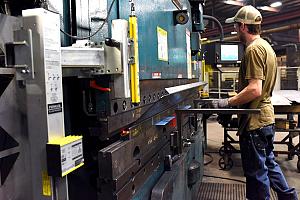
Whether you are an owner, employer, operator, tool setter, or maintenance person, press brake safety is your business. You are responsible for operating and maintaining your equipment in compliance with recognized safety standards and plain common sense.
Foremost, an organized safety committee is a must if you want to ensure an efficient and productive shop. Even in the smallest shops, a committee can review your plant's safety procedures and make recommendations to eliminate unsafe working habits. Proper operating and safety instructions should be provided not only to new employees but also to experienced people who need a refresher on proper work methods.
According to the Occupational Safety and Health Administration (OSHA), every employer must furnish its workers with a shop that is free of recognized hazards that can cause death or serious injury. A safe workplace and good work habits are good investments. Safe press brake operating conditions depend on detecting existing and potential hazards and taking immediate action to remedy them.
The ANSI B11.3 standard (safety requirements for construction, care, and use of power press brakes) states that employers shall train and instruct operators in the safe methods of performing any operation before beginning work on any operation.
A power press brake is the working part of your production system; however, it is but one part of the system.
Different types of press brakes (e.g., mechanical, hydraulic, or hydramechanical) with different types of controls are suited to a variety of applications. Dual palm buttons should be used to activate the ram when piece parts are small and operators must stand close to the point of operation. Foot switches should be used for long flanged parts when operators are allowed to stand away from the point of operation. Proper point-of-operation safeguarding is a must with each type of press brake.
Press brakes can bend, form, notch, punch, and pierce piece parts when equipped with the right dies. This is the tooling component of the system. Operators can feed piece parts into the system either mechanically or manually, making sure that required guarding is in place.
The final component needed to complete a functioning production system is point-of-operation safeguarding. Press brake users should conduct a thorough analysis of the hazards associated with their operations and consider all the components-piece parts to be formed, type of press brake, tooling, and method of feeding-to select suitable point-of-operation safeguarding. ANSI B11.3 states that "if a point-of-operation guard or device can be used, it shall be used."
A safety-focused maintenance program can be the key to reducing accidents caused by unsafe conditions. A safe-thinking maintenance crew should be familiar with the press brake manufacturer's maintenance recommendations and follow them regularly. Allowing a machine to remain unleveled, dirty, or out of adjustment not only prolongs setup time, but surely is unsafe too.
In short, there is no substitute for a regular and complete press brake maintenance program.
Do:
Don't:
Taking good care of your press brake will prolong the life of the machine, make it safer, and enable you to make more accurate parts faster.
The Fabricator is North America's leading magazine for the metal forming and fabricating industry. The magazine delivers the news, technical articles, and case histories that enable fabricators to do their jobs more efficiently. The Fabricator has served the industry since 1970.
start your free subscription


Easily access valuable industry resources now with full access to the digital edition of The Fabricator.
Easily access valuable industry resources now with full access to the digital edition of The Welder.
Easily access valuable industry resources now with full access to the digital edition of The Tube and Pipe Journal.
Easily access valuable industry resources now with full access to the digital edition of The Fabricator en Español.
In this episode of The Fabricator Podcast, Caleb Chamberlain, co-founder and CEO of OSH Cut, discusses his company’s...