















A guide to fabric slitting line tension rolls
Understanding composition, construction is key to optimizing performance
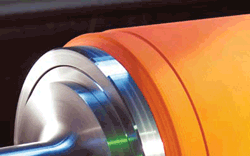
The composition and construction of a roll, its fabric, and how it is finished are critical in understanding how a roll works. Knowing how a roll works, in turn, is the key to optimizing its performance and longevity.
A nonwoven fabric is a combination of natural or synthetic fibers and molten plastics intertwined to form a base or web. Because the roll fabric comprises fibers that vary in diameter and length, the fabric's strength and flexibility exceed that of any of the individual fibers. Adding a polymer-binding agent to the fabric enhances its mechanical properties.
The fabric has a large number of voids, or open spaces. This open structure allows the fabric to pick up and hold dirt and fluid much like a sponge does. As the fabric is compressed onto a roll core, some of the voids get compressed. Thus, a roll with 93 Shore A hardness potentially has less open structure than the same roll compressed to a net hardness of 85 Shore A.
How Fabric Is Made
To understand how nonwoven fabric works, it's important first to learn how it is made. Of the many processes used to produce nonwoven fabrics, all share three main steps: web forming, bonding, and finishing.
Forming is the process of bringing together individual fibers of various diameters and lengths and weaving them together to form a random pattern or web. Bonding sometimes is applied to provide specific mechanical enhancements, such as added resiliency against cuts, tears, and abrasion. Finishing may involve sealers or repellents and even include printing or embossing.
The roll production process has five steps: testing and engineering, die cutting, pressing, finishing, and validating and documenting.
- Testing and Engineering. Pressing tests simulate your machine. The roll manufacturer should use your fluids and a roll covering best suited to the application. Next, a finite element analysis (FEA) of your roll core determines the natural bending of the roll.
- Die Cutting. A computer-controlled die cutter cuts separate disks from a sheet of nonwoven fabric.
- Pressing. Disks are pressed onto the roll core using the correct loading procedure for the material. Pressing provides a uniform density and hardness of the covering along the length of the roll face. The material then is compressed onto the roll shaft at an approximate rate of 3-to-1.
- Finishing. The roll is turned and ground to the finished size and appropriate diameter.
- Validating and Documenting. After the roll has been completed, it is checked for surface finish and consistent hardness. The journals and bearings (if included) are inspected before and after crating for shipment. A complete report of the roll's condition at shipment is provided to you.
How Rolls Work
Nonwoven fabrics work like a sponge that pumps fluid off and onto the steel as the rolls rotate. To achieve optimal tension, three elements work together during roll operation:
- Void volume
- Pressure (PLI)
- Roll footprint
Void Volume. Void volume is an indication or measure of the amount of open space between the combined fibers and binder material web in a nonwoven fabric. Void volume has a direct impact on the ability of a nonwoven roll to pick up dirt and wring oil off steel.
- The voids let liquid in and out again. The holes must be the optimal size for the application.
- The void area allows a high coefficient of friction, which enables the roll to grip metal. Consequently, when the void is inadequate for a given application, it can fill up, causing the roll to lose friction and allowing the metal to skid or slip.
- The void affects how long a roll performs before dirt fills the void and the roll's performance deteriorates.
PLI. Pounds per linear inch, or PLI, is used to indicate the amount of pressure, in pounds, per linear inch across the face of two rolls as they come together. PLI is used to calculate roll force. It is a common term used by the roll producer, machine builder, and end user to describe the force exerted on and through the rolls.
Roll Footprint. Proper PLI ensures that the rolls' contact points create an adequate footprint. This, in turn, allows you to establish the proper roll loading (or footprint) to achieve desired results. Understanding PLI and the footprint lead to proper machine setup.
Inspection, Installation, and Setup
Following inspection, installation, and setup procedures that protect the roll covers can help you to extend their useful service life.
Inspection
- Review the inspection report of new or reground rolls to ensure the rolls were manufactured to your specifications.
- Verify that the roll cover diameters are ±0.010 in. if your coil processing line uses a common drive. If it has separate drives, verify that their speeds, measured in revolutions per minute, differ by less than 1 percent.
- Verify that the roll cover concentricity, or runout, is less than 0.010 in. when compared with the bearing journals. The taper from end to end should not exceed 0.005 in.
- Measure the roll hardness with a durometer. The readings must be within 5 Shore A points across each roll face.
- Verify the dimensions of the bearing journals to ensure they conform to the manufacturer's recommended tolerances.
- Confirm that straightener, feeder, and other components on the line have a common centerline.
Installation and Setup
- Install the rolls on center, level, and parallel to each other and the machine.
- Remove the packing material.
- Adjust the rolls up or down to align the roll surfaces with the original passline of the machine, whether the rolls are new or reground.
- Use a feeler gauge to align them so the gap between the rolls does not exceed 0.015 in. from end to end.
- Set the roll force on the cylinders or jackscrews in accordance with the roll and machine builder's recommended operating pressure.
- Check the pressure using one of the following three methods:
- Place a continuous strip of cardboard between the rolls and bring the rolls down to clamp onto the cardboard at the operating pressure. After 30 seconds, open the rolls and remove the cardboard. A consistent image along the length of the cardboard indicates the pressure is balanced across the roll face.
- Insert StoFoil or another type of pressure-sensitive paper or film to check the footprint across the roll face.
- Carefully (so as not to damage the roll surface) check for gaps or breaks using a feeler gauge.
- Vary the pressure setting, ensuring that the pressure is balanced from side to side, until the footprint conforms to specification.
- If in doubt, use a load cell to take a direct reading at each cylinder or jackscrew to ensure even pressure application on each end of the roll during run-in.
- Use an initial run-in procedure on new rolls: Rotate the rolls (use the jog control) at normal roll force. This distributes internal stresses evenly across the roll face. If you skip this step, you might only partially relieve the stress. For example, processing a narrow coil results in relieving internal stresses only where the coil contacts the roll.
Roll Operation
Proper operation extends the roll service life and reduces the amount of reconditioning needed when service is necessary.
Verify Roll Diameters. Rolls for common drive systems are manufactured in pairs with identical diameters. Rolls with matching diameters rotate at the same speed, which helps ensure that they perform correctly. If rolls are not matched, they will operate at different speeds, leading to loose coils, premature roll wear, roll skidding, part damage (including binding, tearing, and wrinkling), unpredictable steering, oil lines or streaks on the coil, uneven strip tension, and premature bearing wear.
[image4]Slitter Head Setup. Set up the slitter head at the center of the slitter mandrel whenever possible. Repeatedly setting up the slitter head to the left or the right of center causes uneven wear on the tension rolls. Uneven wear causes steering and tracking problems and reduces the rolls' service life.
Setting the Force. Use just enough roll force and brake force to provide equal tension on each slit coil section. The force and brake amounts vary; they depend on the metal gauge, coil width, and the number of slit sections. Use additional roll and brake force for the first five to 10 wraps on the recoiler, then reduce the force.
Inline Maintenance. When the rolls are not in use (between slitter head setups, for instance), run them under normal roll force in jog mode to wring excess oil and dirt from the roll surface and void areas. This helps to maintain the coefficient of friction and provides equal tensioning across the roll face.
This operation also levels the roll surface. For example, when slitting a narrow coil, the entire roll face does not engage the metal, resulting in minor waves or edge marks in the area of the metal path. Applying roll force to the entire face reduces or removes the waves and edge marks, thus increasing the tension consistency across subsequent wide coils.
Troubleshooting
Check for the following when you notice steering problems:
- Unparallel rolls
- Uneven roll wear
- Overpressuring or excessive brake
- Excessive variation of roll hardness across the roll face
- Improper grinding, which can result in roll taper, mismatched diameters, or excessive roll runout
- Slitter head not centered
- Excess camber in the coil
- Coil sections too close to roll locking collars
Check the following points when you notice slipping:
- Roll surfaces are loaded with oil, dirt, and metal fines, requiring a wring-out procedure or grinding
- Excessive roll force, brake force, or both
- Excessive roll wear through the center section of the rolls, causing the majority of roll force to be applied to the larger roll ends
- Excessive mismatch in tension rolls and recoiler speed
When the rolls have accumulated too much oil, dirt, or metal particles to grip coil, return them to the manufacturer for service. This is a matter of cutting them down to remove the excess dirt and oils that have loaded the surface voids. The normal service cycle is six to 12 months, depending on the metal type and the number of operational hours.
Jim Rusczyk is managing director and Doug Goetz is general manager for FKM USA LLC, 400 S. LaGrange Road, Unit A, Frankfort, IL 60423, 815-469-2473
About the Authors
About the Publication

subscribe now
The Fabricator is North America's leading magazine for the metal forming and fabricating industry. The magazine delivers the news, technical articles, and case histories that enable fabricators to do their jobs more efficiently. The Fabricator has served the industry since 1970.
start your free subscription- Stay connected from anywhere

Easily access valuable industry resources now with full access to the digital edition of The Fabricator.

Easily access valuable industry resources now with full access to the digital edition of The Welder.

Easily access valuable industry resources now with full access to the digital edition of The Tube and Pipe Journal.

Easily access valuable industry resources now with full access to the digital edition of The Fabricator en Español.
- Podcasting

In this episode of The Fabricator Podcast, Caleb Chamberlain, co-founder and CEO of OSH Cut, discusses his company’s...
- Trending Articles
1
AI, machine learning, and the future of metal fabrication

2
Employee ownership: The best way to ensure engagement

3
Steel industry reacts to Nucor’s new weekly published HRC price
4
Dynamic Metal blossoms with each passing year

5
Metal fabrication management: A guide for new supervisors