






Director of Sales, Stoody brand

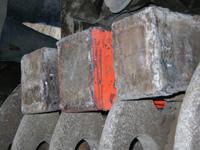
Rock-crushing hammers like the ones shown suffer wear caused by impact abrasion, the most common form of component wear. Hardfacing alloys containing
A number of product innovations have improved the performance of hardfacing equipment. Currently 20 or so standard alloys can meet the needs of most applications, simplifying the selection process.
Selecting the appropriate hardfacing alloy can be an intimidating experience. However, learning to ask the right questions will help you make the decision that’s best for your application.
Most hardfacing issues relate to metal-to-metal wear, impact wear, impact and abrasive wear, straight abrasive wear, and abrasive wear accompanied by corrosion or high temperatures.
Metal-to-metal wear is caused by the friction generated when two metal surfaces rub against each other while rotating under a load. Galling sometimes is present, which is the transfer of metal between the two components. This type of wear is found mostly in applications involving shaft sleeves, bearing surfaces, and track idlers found on earthmoving tractors.
Impact wear is found where a medium is subjected to reduction through a crushing operation. In rock crushing, for example, solid particles of rock are brought in contact with metal hammers, rolls, or bowls. This impact causes the deformation of the base metal, reducing the efficiency of the equipment’s wear components. Normally, a work-hardening manganese-type buildup product is used for this type of repair.
The most common form of wear is impact in combination with abrasive wear. In this type of application, the component comes in contact with solid and fine particles. Such applications include bucket teeth, trenching tools, and agricultural parts.
Straight abrasive wear is pretty rare but generally occurs in conveyor chutes, sand processing components, or earth-tilling applications where metal loss is caused by metal-to-earth contact. Impact is not a huge concern as the particles of the medium being moved or tilled are generally small.
The final category is wear accompanied by corrosion and even high temperature. Applications include hot forging dies, digester rotors, food processing components, and plastic extrusion equipment.
A number of techniques can be used in the field to identify base metal.
The preferred method is simply to read the equipment manual or contact the OEM for the precise information. Why is this important? All metals react differently when welded. Cast irons require a great deal of caution due to their crack sensitivity. Manganese steels must never be allowed to reach 400 degrees or they will transform and become brittle. High-carbon steels require preheats according to the amount of carbon present in the base metal. Specific information is available from all hardfacing manufacturers in the form of heat-treat charts and preheat recommendations.
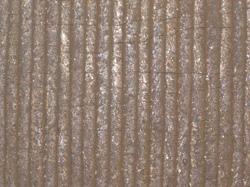
Alloys containing manganese are recommended for components that have suffered wear caused by straight abrasion, in which impact is low and the material that is in contact with the component generally is small.
The type of wear that your component is exposed to generally determines the type of hardfacing alloy you need. Below is a general selection guide for matching mode of wear with the appropriate alloy.
Now that you have an idea about the wear, the base metal, and the alloy you wish to use on your specific application, you should confirm which welding process you will use to make the repair. Hardfacing repair alloys are available for every commonly used welding process (GMAW, SMAW, FCAW, and GTAW). Likewise, any of the processes will achieve satisfactory results.
Wires also are available for twin-wire arc thermal spray and powders used via plasma transfer arc. Some OEMs even laser-weld, which further reduces the heat-affected zone and provides a clean, homogenous deposit.
The last item to consider is the alloy diameter and packaging. This depends on the process, your equipment, and the material to be welded. For example, small or thin pieces of metal require less heat input and typically a smaller-diameter consumable.
Obviously, if you have a combination power supply/wire feeder, you will not have the ability to weld large spools and high-amperage (large-diameter) products. None of these issues should be perceived as barriers since products are available in diameters from 0.035 to 0.250 in. Hardfacing alloys come in packages from 5-lb. boxes to 750-lb. continuous-feed drums.
Hopefully, this general discussion will encourage you to consider hardfacing to repair and extend the life of your components subjected to wear. Most manufacturers have product specialists to assist you in the selection of alloys. They also offer a number of tools such as wall charts, selection guides, and pocket brochures.

The Welder, formerly known as Practical Welding Today, is a showcase of the real people who make the products we use and work with every day. This magazine has served the welding community in North America well for more than 20 years.
start your free subscription


Easily access valuable industry resources now with full access to the digital edition of The Fabricator.

Easily access valuable industry resources now with full access to the digital edition of The Welder.
Easily access valuable industry resources now with full access to the digital edition of The Tube and Pipe Journal.
Easily access valuable industry resources now with full access to the digital edition of The Fabricator en Español.
In this episode of The Fabricator Podcast, Caleb Chamberlain, co-founder and CEO of OSH Cut, discusses his company’s...