

















Director, Procurement Technical Assistance Center

 |
So you have your contract and have delivered on time and within specification. Now it's time to address payment.
Getting paid is a fascinating topic to discuss. Some companies fight tooth and nail to get in with commercial contractors because they think they're easy to deal with, but they also admit that cash flow can be a problem.
"Major prime commercial contractors pay in 90 or 120 days, if they pay at all," some say.
The federal government is different. By law, the government must pay you in 30 days or less. Currently, you can get paid in about 15 days with electronic funds transfer (EFT). The catch, however, is that the clock starts running only when the government receives a proper invoice. You are responsible for sending out an invoice that's filled out correctly.
To pay you, the government needs to know:
You may use your own company invoice with the government, but if you do, you must make sure it meets these requirements. If it doesn't, it can slow or stop payment. It may be easier to use the government DD Form 250; this is a material inspection and receiving report (MIRR). If you're working with a packaging house that's used to dealing with the government, they can complete this form for you. The form can be used for:
This form can help you keep track of your government contracts. The government even provides an explanation of the form and its use.
Most Procurement Technical Assistance Centers (PTACs) hold classes or workshops on how to fill out DD Form 250. You also can get help from a local federal government small-business office. To find one in your area, visit www.dod.mil/dfas/comm pay/vptraining.htm.
Also, PTAC mailing lists often include information on Wide Area Workflow (WAWF). An electronic document delivery system, WAWF helps you get paid on time by reducing lost or misplaced documents; helps you route documents quickly; offers opportunities for discounts; provides total visibility of document status; eliminates the cost and time of U.S. mail; secures transactions with an audit trail; and provides downloadable software from the Internet at no cost.
Another note: If you're going to fill out several bids, visit the Online Representations and Certifications Application (ORCA). This e-government initiative replaces the paper-based representations and certifications process you see in bid documents. To fill it out, you must have a CCR and have all your information in front of you when you get online. To find out what ORCA is and what information is available, visit https:// orca.bpn.gov/faq.aspx.
Once you have registered with these offices and sites, you will be on your way to getting paid. As always, if you need help, contact your local PTAC.
John DiGiacomo is the director of the Rock Valley College Procurement Technical Assistance Center, 605 Fulton, Rockford, IL 61103, 815-921-2091, JDiGiacomo@ rvc.cc.il.us, www.wingov.com.
Jim Kleckner is a retired acquisition specialist from the Department of Defense and owner of Government Contracting Assistance, 2168 Spaulding Ave., West Dundee, IL 60118-3521, 847-426-7003, klecknerj@yahoo.com.
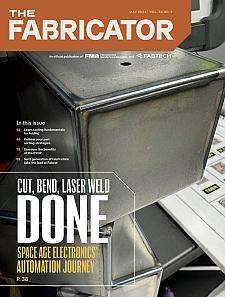
The Fabricator is North America's leading magazine for the metal forming and fabricating industry. The magazine delivers the news, technical articles, and case histories that enable fabricators to do their jobs more efficiently. The Fabricator has served the industry since 1970.
start your free subscription

Easily access valuable industry resources now with full access to the digital edition of The Fabricator.

Easily access valuable industry resources now with full access to the digital edition of The Welder.
Easily access valuable industry resources now with full access to the digital edition of The Tube and Pipe Journal.
Easily access valuable industry resources now with full access to the digital edition of The Fabricator en Español.
In this episode of The Fabricator Podcast, Caleb Chamberlain, co-founder and CEO of OSH Cut, discusses his company’s...