







Editor-in-Chief

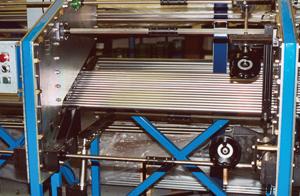
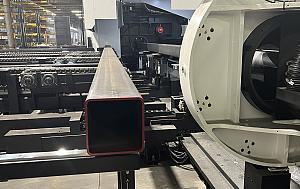
Stealth Manufacturing Inc. fabricated its own tube unloader for its cutoff line. Instead of relying on special Allen wrenches to adjust the unloader each time a different-sized tube is switched out, the operator just turns the hand cranks for quicker changeovers.
Editor's Note: This feature about Stealth Manufacturing Inc. does not contain quotes because the company president asked that names be withheld from the final story so that the entire company can share the spotlight, not just a few. We have acknowledged this request.
Most fabricators like to tinker. They fabricate their own racks and fixtures, and they might have hobbies, such as metal sculpture or customizing old automobiles, which allow them to use their skills in and out of the shop.
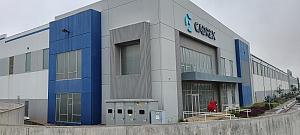
Stealth Manufacturing Inc., Savage, Minn., takes tinkering to the next level. The tube fabricating shop is customizing automated machine tools and production aids that are helping it to become the dominant player in a segment of the gas tube industry.
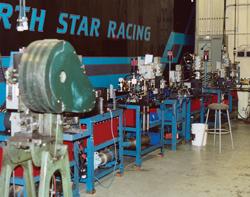
Stealth Manufacturing began life as North Star Machine Co. back in 1978. The shop mostly did screw machine work for clients in the Minneapolis area, but that changed in the late 1980s.
After some market research, North Star decided concentrating on the heater tube business for gas fireplaces and appliances made sense. The market wasn't directly served by dedicated metal fabricating shops, and the OEMs basically were designing products originally designed for the HVAC industry.
On the technology side, the North Star brain trust developed its first CNC machine to punch holes in tubing. On the marketing side, the brain trust sent a promotional flier to about a dozen gas fireplace manufacturers. The two-pronged plan worked unbelievably well.
The phone was ringing off the hook, and North Star Machine began its growth spurt. By 1990 North Star Machine was only a name on the outside of the building and on some invoices from longtime material suppliers. Stealth Manufacturing had stolen the spotlight.
Stealth Manufacturing's ability to make its own equipment is at the heart of its success. It can deliver almost anything because it has the means to create the equipment that can do it.
Such expertise has helped the company take a commodity item—gas heater tubes—and turn it into a fabrication unique to each gas fireplace design. The tube fabricator learned over the years that different tube shapes—round or flat pan—and hole configurations on the tube can create different fire shapes and colors behind ceramic logs. The company also works with a variety of sizes—1⁄4- to about 4-inch-diameter tube—and materials, the most popular being aluminized and stainless steel. Stealth Manufacturing management estimates it now has about 4,000 gas heater designs in its database, dating back to 1988.
Thirty of its 40 fabricating machines used to produce those designs have been engineered and manufactured based on in-house designs. Here are some automation examples:
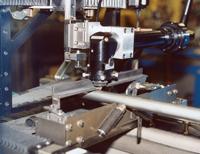
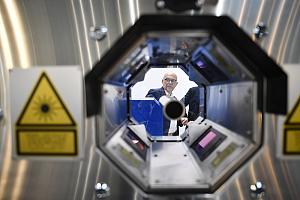
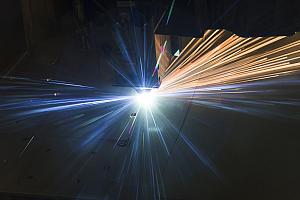
Stealth built its own laser cutting machine with capabilities to make very fine 3-D cuts and standard 3-D cuts. It purchased a 240-W Synrad laser resonator for cutting tube for medical applications and a 2,000-W Rofin-Sinar resonator for industrial cutting and then mounted them on the same machine. The laser cutting heads are designed for quick changeout when switching between the resonators. An operator only has to turn a bolt, take out the laser head, set it aside, insert the new laser head with articulated arm, and turn on the corresponding resonator.
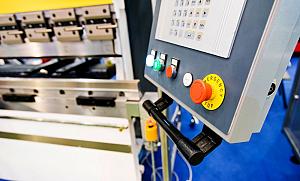
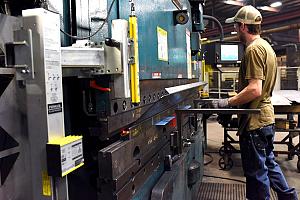
The tube fabricator also designs and fabricates its own quick-change tooling. All 16 of the company's bending machines feature tooling that is interchangeable, even though equipment ages are from just 4 to 50 years old.
By the late 1990s, Stealth Manufacturing had 36 employees, and manufacturing was booming. Unfortunately, shop floor activity was becoming unmanageable.
One day managers spent a morning looking out the window of a second-floor office and watching shop floor activity. Management witnessed a large amount of time dedicated to support activities, such as mopping floors, moving material around, boxing parts, chasing tools, and setting up jobs, rather than time dedicated to fabricating metal parts.
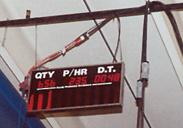
Management wanted to draw employees' attention to the amount of time spent not making parts. Stealth Manufacturing contracted with an electrical engineer to write a software program to help track downtime. The software was then put into a processor that was connected to a 'scoreboard' made by a local sign manufacturer. The first Industrial Scoreboard™ was born in 1999.
The Scoreboard tracks quantity of parts produced over a shift, parts produced per hour, and total downtime resulting from stoppages related to nonfabricating activities. The software figures out the appropriate time based on early-shift fabricating activities; after an operator completes several fabrications, the software has an idea as to how much time it should take to fabricate one metal part completely.
When the first signs went up over fabricating cells, workers were unnerved. Some never got over the feeling that Big Brother was watching, and they left. Others embraced the idea and actually used the tool to justify their pay increases during annual job reviews.
Today all workcells are attached to the Industrial Scoreboards at Stealth Manufacturing. In fact, some other companies have actually adopted the tool as well.
So Stealth Manufacturing employees have bought into the idea of minimizing downtime, but what happens when downtime occurs because an employee is unable to tend to a machine because of other shop floor obligations?
Company management began to explore that issue when it was looking for ways to have employees work more efficiently and keep machines running as much as possible. Sometimes machines needed quicker attention because material changeover was needed at the end of a production cycle. Other times a manufacturing glitch, such as a tip-up on the laser cutting machine, would cause the equipment to end the fabricating process, and the operator wouldn't know about the problem until he walked over at the time he expected the production cycle to be concluded, which could be many minutes later in some instances.
Stealth Manufacturing developed The Attendant™, a paging system connected to equipment that lets an operator know his attention is needed. A microswitch is attached to the shutter light on a machine, and when the machine stops running, because material changeout is needed or a production error occurs, the shutter light goes off, tripping the switch that sends a message to pagers carried around by machine operators. The pager vibrates and delivers a text message, such as 'Mazak needs attention.'
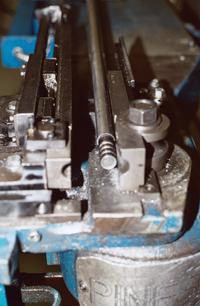
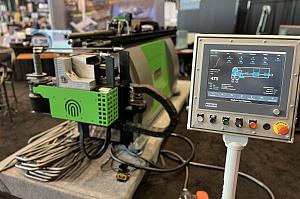
Stealth has 16 tube benders from Pines Manufacturing Inc., including one from 1946, and all of the machines have the same custom quick-change tooling designed and built by in-house staff.
Stealth Manufacturing likes to describe itself as a machine development company that produces parts for customers. It believes such an approach keeps them ahead of competitors—both in North America and abroad—and forces competitors to play catch-up while Stealth is already on to next-generation manufacturing practices.
Faced with a more competitive manufacturing environment, the company thinks its investments and employees' collective talent have put it in a good position to succeed.

The Fabricator is North America's leading magazine for the metal forming and fabricating industry. The magazine delivers the news, technical articles, and case histories that enable fabricators to do their jobs more efficiently. The Fabricator has served the industry since 1970.
start your free subscription


Easily access valuable industry resources now with full access to the digital edition of The Fabricator.

Easily access valuable industry resources now with full access to the digital edition of The Welder.
Easily access valuable industry resources now with full access to the digital edition of The Tube and Pipe Journal.
Easily access valuable industry resources now with full access to the digital edition of The Fabricator en Español.
In this episode of The Fabricator Podcast, Caleb Chamberlain, co-founder and CEO of OSH Cut, discusses his company’s...