








AWS CWI, CWE, NDE Level III

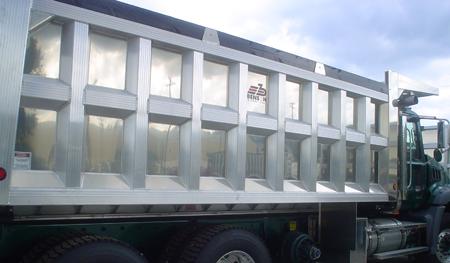
This aluminum truck body is lined with abrasion-resistant plate to help it withstand an abrasive environment. Liners usually are plug or slot welded to the aluminum bodies. Liner thickness and hardness are determined by the abrasiveness and impact force of the material to be hauled in the truck.
Many materials do not conform to ASTM, ASME, or SAE standards for chemical or mechanical properties. Nonconformity is very common for abrasion resistant materials. Although these materials are used most frequently as liner plates, sometimes they are used to fabricate a complete unit. This creates a problem for the fabricator that has to develop a welding procedure.
Those of us who are familiar with the required formats in the codes find that extra effort is necessary in selecting welding materials with common trade names..
Many materials do not conform to ASTM, ASME, or SAE standards for chemical or mechanical properties. Nonconformity is very common for abrasion resistant materials. Although these materials are used most frequently as liner plates, sometimes they are used to fabricate a complete unit. This creates a problem for the fabricator that has to develop a welding procedure.
Those of us who are familiar with the required formats in the codes find that extra effort is necessary in selecting welding materials with common trade names.Some material producers attempt to tie AR to ASTM A514; however, even though there are some similarities, this material does not fit the A514 specifications (Figure 1a, Figure 1b, and Figure 1c).
| Grade | Thickness (In.) | Min. or Max. | C | Mn | P | S | Si | Cr | Mo | V | Ni | Cm | B |
| ASTM A514F Requirements | 1/4 - 3/4 | Min. | .10 | 1.10 | .15 | .10 | .001 | ||||||
| Max. | .20 | 1.50 | .02 | .009 | .35 | .35 | .06 | .005 | |||||
| 7/8 - 2 | Min. | .10 | 1.10 | .15 | .10 | .001 | |||||||
| Max. | .20 | 1.50 | .02 | .009 | .35 | .35 | .06 | .005 | |||||
| ASTM A400 Brand XBrinell hardness: 370 to 388 | 1/4 - 3/4 | Min. | .10 | .10 | .001 | ||||||||
| Max. | .20 | 1.70 | .02 | .010 | .70 | .005 | |||||||
| 7/8 - 11/4 | Min. | .10 | .10 | .001 | |||||||||
| Max. | .20 | 1.70 | .02 | .010 | .70 | 1.00 | .70 | .005 | |||||
| 11/2 - 2 | Min. | .10 | .10 | .001 | |||||||||
| Max. | .20 | 1.70 | .02 | .010 | .70 | 1.00 | .70 | .005 | |||||
| 21/4 - 3 | Min. | .15 | .001 | ||||||||||
| Max. | .26 | 1.20 | .015 | .009 | .70 | 1.00 | .50 | 1.00 | .005 | ||||
| ASTM A400 Brand ABrinell hardness: 397 | Any size | Max. | .17 | 1.55 | .025 | .005 | .55 | .55 | .55 | 1.00 | |||
| Figure 1a ASTM A514F is the standard, and the various brands differ from the standard. The differences in metallurgical content make the material stronger yet more workable. | |||||||||||||
| Thickness | Ultimate Tensile Strength (KSI) | Minimum Yield Strength (KSI) | Elongation (Percent) | Reduction of Area (Percent) | Brinell Hardness |
| Less than ¾ | 110 – 130 | 100 | 18 | 40 | 235 - 293 |
| ¾ to 2½ | 110 – 130 | 100 | 18 | 40 | |
| More than 2½ | 110 – 130 | 90 | 16 | 50 | |
| Figure 1b | |||||
| ASTM A400 Brand XX | ||||||||||||
| C/Ti | Mn/Sn | P/N | S/As | Si/Zr | Cr/Pb | Ni/Sb | Cu | Mo | Al | Cb | V | B |
| .13 to .031 | .127 | .015 | .003 | .17 | .07 | .02 | .10 | .19 | .025 | 0 | .004 | .0013 |
| Figure 1c The 12 percent elongation indicates that the material is not ductile, which means that a complete ductility test on the material and on a weld sample must be conducted. | ||||||||||||
The manganese content is higher in Brand X 400, so it is stronger without being more brittle. Also note that the chromium and molybdenum content are higher in Brand X 400F, which adds to the strength, wear resistance, and heat-treatability. In the 2¼-in. to 3-in. Brand X 400F material, the carbon content is higher and the manganese is lower, but nickel is added for more ductility, hardenability, and toughness. This also tends to compensate for the need for higher carbon.
I am not in the business of selling metal, but I am convinced through research and experience in using this type of material that Brand A and Brand X are very good quenched and tempered steels. Brand XX is relatively new in our area and I have had minimal experience with it. From my limited point of view, it appears to be worth looking into as a viable resource for abrasion resistance. The producer seems to push the “work-hardening” aspect of the material. I look at the formability and ease of welding, punching, and cutting in addition to the quality of the end product. If the proper procedures and proper weld material and preheat are used, you should have no trouble fabricating any of these materials.
The Brands A400F, X400F, and XX400F are not classified or specified by ASTM, ASME, or SAE/AISI, or even listed in the common trade name section of the Unified Numbering System standard. This doesn’t mean that these products are not fit for their purpose. It does, however, create some problems for writing welding procedures. It is difficult to place these alloys in an AWS group or to use a “P” designation when writing an ASME procedure. “Typical” chemical and mechanical documents are available for each of them, but some end users (fabricator customers) will not accept typical material test reports.
Note that the 0.17 percent carbon content in Brand A400F is not listed by thickness as the Brand X and A514 are listed. I assume that this is an average for all sizes. The somewhat low carbon content in these materials allows them to be welded fairly easily. Caution is advised regarding the materials’ “carbon equivalency”. A formula containing the carbon, manganese, chromium, molybdenum, and nickel must be used. Ductility may be determined by tensile, yield, elongation, and reduction of area tests. A guided bend test is useful to determine the minimum and maximum bend radius. Also, it is a very good idea to do a complete weld coupon test to determine the ductility of a welded part. You must use the inspection rule that applies to all quenched and tempered material—perform a final inspection 48 hours after welding. The possibility of delayed cracking is prevalent with these materials.
Figure 1 shows an actual material test report for a 0.500-in.-thick AR400F plate. (This is not from a trade-name producer.) I have never observed a material test report in this format. The combination of elements is probably to protect the proprietary nature of the chemical and mechanical properties of the material. Since producers of trade-name materials are not required to use any of the national standards for chemical content reporting, they are able to issue reports such as this one.
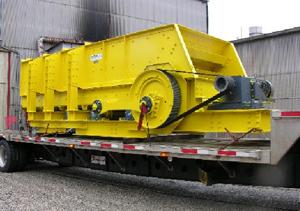
Figure 2
A reciprocating feeder uses large amounts of AR material. The liner plates are bolted in for easy replacement. They sometimes are plug- or slot-welded in. Several of these units have been in service for many years without requiring liner replacements.
For corrosive environments, the liners are made of stainless steel. Some stainless steel, such as Type 347, is also somewhat abrasion-resistant. The higher manganese content promotes work hardening. If it is welded in, a 309 series wire or electrode is used.
Photo courtesy of Wayne Mullins, Kanawha Manufacturing quality inspector.
The 12 percent elongation indicates that the material is not ductile, which means that a complete ductility test on the material and on a weld sample must be conducted. The combined reporting of the carbon and titanium obviously indicates that the material contains titanium carbides. This actually presents the exact amount of each of these two elements. However, none of the other combinations—manganese/tin (Mn/Sn), phosphorus/nitrogen (P/N), sulfur/arsenic (S/As), silicon/zirconium (Si/Zr), chromium/lead (Cr/Pb), and nickel/americacium (Ni/Sb)—note the specific amounts of each element. I suppose the arsenic and lead elements could be frightening to health and safety personnel, but I am fairly certain that there is no basis for concern since many earthen substances contain these elements.
It would be difficult to calculate the carbon equivalency using this report. For instance, how much (what percentage) manganese or chromium is actually in the material? Because the elements are combined, it is impossible to determine the carbon equivalency without a metallurgical analysis. The tensile strength may be determined fairly accurately by a comparison chart that equates hardness to tensile strength. These charts are available online from many steel producers.
Please do not assume that I am attempting to downplay any of these materials. The purpose of this article is to portray the many differences among AR materials. I work with them regularly, and every one of these materials has a place in industry. My company manufactures equipment for handling coal, coke, aggregate, and other abrasive materials. We use AR material for liner plates in dump trucks, coal feeders, dozer blades, end-loader buckets, coal classifiers, and in our specialty, which is a reciprocating feeder (Figure 2) for coal and other abrasive materials. These AR materials greatly enhance the life of the equipment.
AR material providers readily supply information concerning welding, machining, bending, and rolling procedures and answer specific questions. Technical information about these materials also is available online at providers’ Web sites.
An alternative to the abrasion-resistant steel is ceramic tile. One disadvantage to this material is its inability to resist impact. Tiles can crack and cause many problems if they fall into a machine with moving parts. The tile is so hard that it can damage gears or sprockets extensively and must be measured by the measurement of hardness (MOH) method; ordinary Brinell or Rockwell equipment cannot be used.
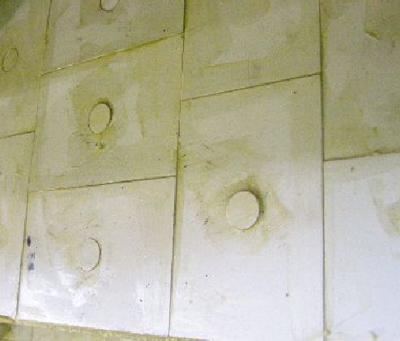
Another problem is that the ceramic is joined to the part with an adhesive substance (Figure 3). If the adhesive is exposed to excessive heat, the tiles can break loose.Ceramic tile is very useful in slurry conveyance equipment that encounters only abrasion or corrosion.
The manganese content is higher in Brand X 400, so it is stronger without being more brittle. Also note that the chromium and molybdenum content are higher in Brand X 400F, which adds to the strength, wear resistance, and heat-treatability. In the 2¼-in. to 3-in. Brand X 400F material, the carbon content is higher and the manganese is lower, but nickel is added for more ductility, hardenability, and toughness. This also tends to compensate for the need for higher carbon.
I am not in the business of selling metal, but I am convinced through research and experience in using this type of material that Brand A and Brand X are very good quenched and tempered steels. Brand XX is relatively new in our area and I have had minimal experience with it. From my limited point of view, it appears to be worth looking into as a viable resource for abrasion resistance. The producer seems to push the “work-hardening” aspect of the material. I look at the formability and ease of welding, punching, and cutting in addition to the quality of the end product. If the proper procedures and proper weld material and preheat are used, you should have no trouble fabricating any of these materials.
The Brands A400F, X400F, and XX400F are not classified or specified by ASTM, ASME, or SAE/AISI, or even listed in the common trade name section of the Unified Numbering System standard. This doesn’t mean that these products are not fit for their purpose. It does, however, create some problems for writing welding procedures. It is difficult to place these alloys in an AWS group or to use a “P” designation when writing an ASME procedure. “Typical” chemical and mechanical documents are available for each of them, but some end users (fabricator customers) will not accept typical material test reports.
Note that the 0.17 percent carbon content in Brand A400F is not listed by thickness as the Brand X and A514 are listed. I assume that this is an average for all sizes. The somewhat low carbon content in these materials allows them to be welded fairly easily. Caution is advised regarding the materials’ “carbon equivalency”. A formula containing the carbon, manganese, chromium, molybdenum, and nickel must be used. Ductility may be determined by tensile, yield, elongation, and reduction of area tests. A guided bend test is useful to determine the minimum and maximum bend radius. Also, it is a very good idea to do a complete weld coupon test to determine the ductility of a welded part. You must use the inspection rule that applies to all quenched and tempered material—perform a final inspection 48 hours after welding. The possibility of delayed cracking is prevalent with these materials.
Figure 1 shows an actual material test report for a 0.500-in.-thick AR400F plate. (This is not from a trade-name producer.) I have never observed a material test report in this format. The combination of elements is probably to protect the proprietary nature of the chemical and mechanical properties of the material. Since producers of trade-name materials are not required to use any of the national standards for chemical content reporting, they are able to issue reports such as this one.
The 12 percent elongation indicates that the material is not ductile, which means that a complete ductility test on the material and on a weld sample must be conducted. The combined reporting of the carbon and titanium obviously indicates that the material contains titanium carbides. This actually presents the exact amount of each of these two elements. However, none of the other combinations—manganese/tin (Mn/Sn), phosphorus/nitrogen (P/N), sulfur/arsenic (S/As), silicon/zirconium (Si/Zr), chromium/lead (Cr/Pb), and nickel/americacium (Ni/Sb)—note the specific amounts of each element. I suppose the arsenic and lead elements could be frightening to health and safety personnel, but I am fairly certain that there is no basis for concern since many earthen substances contain these elements.
It would be difficult to calculate the carbon equivalency using this report. For instance, how much (what percentage) manganese or chromium is actually in the material? Because the elements are combined, it is impossible to determine the carbon equivalency without a metallurgical analysis. The tensile strength may be determined fairly accurately by a comparison chart that equates hardness to tensile strength. These charts are available online from many steel producers.
Please do not assume that I am attempting to downplay any of these materials. The purpose of this article is to portray the many differences among AR materials. I work with them regularly, and every one of these materials has a place in industry. My company manufactures equipment for handling coal, coke, aggregate, and other abrasive materials. We use AR material for liner plates in dump trucks, coal feeders, dozer blades, end-loader buckets, coal classifiers, and in our specialty, which is a reciprocating feeder (Figure 2) for coal and other abrasive materials. These AR materials greatly enhance the life of the equipment.
AR material providers readily supply information concerning welding, machining, bending, and rolling procedures and answer specific questions. Technical information about these materials also is available online at providers’ Web sites.
An alternative to the abrasion-resistant steel is ceramic tile. One disadvantage to this material is its inability to resist impact. Tiles can crack and cause many problems if they fall into a machine with moving parts. The tile is so hard that it can damage gears or sprockets extensively and must be measured by the measurement of hardness (MOH) method; ordinary Brinell or Rockwell equipment cannot be used.
Another problem is that the ceramic is joined to the part with an adhesive substance (Figure 3). If the adhesive is exposed to excessive heat, the tiles can break loose.Ceramic tile is very useful in slurry conveyance equipment that encounters only abrasion or corrosion.

AWS CWI, CWE, NDE Level III
Weld Inspection & Consulting
The Fabricator is North America's leading magazine for the metal forming and fabricating industry. The magazine delivers the news, technical articles, and case histories that enable fabricators to do their jobs more efficiently. The Fabricator has served the industry since 1970.
start your free subscription


Easily access valuable industry resources now with full access to the digital edition of The Fabricator.

Easily access valuable industry resources now with full access to the digital edition of The Welder.
Easily access valuable industry resources now with full access to the digital edition of The Tube and Pipe Journal.
Easily access valuable industry resources now with full access to the digital edition of The Fabricator en Español.
In this episode of The Fabricator Podcast, Caleb Chamberlain, co-founder and CEO of OSH Cut, discusses his company’s...