









Professor Emeritus and Director - Center for Precision Forming

Editor's Note: This column was prepared by the staff of the Engineering Research Center for Net Shape Manufacturing (ERC/ NSM), The Ohio State University, Professor Taylan Altan, director.
Various types of sheet hydroforming operations, specifically rubber forming and rubber diaphragm forming, have been used for years in the aircraft industry. Sheet hydroforming is well-suited for prototyping and low-volume production, which are predominant in the aerospace industry.
Recently, however, sheet hydroforming is garnering special attention in the automotive industry for the following applications:
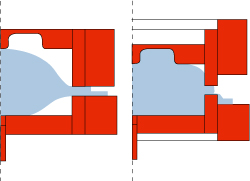
The principle of sheet hydroforming is illustrated in Figure 1. The blank holder is provided with a seal (location 6 in Figure 1). A container (location 5 in Figure 1) maintains the pressure medium, usually water-oil emulsion. A hydraulic servo valve controls the counterpressure (PG) during the process. After the blank is placed on the die, the blank holder presses the sheet and the punch forms the sheet against the medium, creating a pressure that is controlled throughout the punch stroke.
Hydroforming can be used for stretch forming (the flange material is not allowed to flow into the die cavity) or for deep drawing (flange material is allowed to flow into the die cavity).
Other variations of the process include:
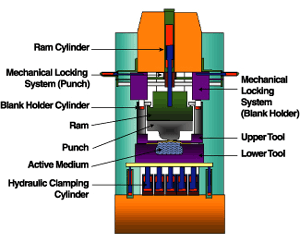
Considerable hydroforming R&D is being conducted in Japan and Germany. Amino and Toyota (www.toyota.com) have used sheet hydroforming technology since the 1980s.1Various German universities, including Stuttgart, Erlangen, and Dortmund, and press manufacturers, including Schuler, Schnupp, and SPS, are building vertical and horizontal hydraulic presses that have short cycle times for production and prototyping applications. Figure 2 illustrates this type of press.2
The long-stroke, small-diameter ram cylinder provides a quick up-and-down stroke. The mechanical slide locking system; the blank holder cylinders; and the short-stroke, high-pressure cylinders located below the press table provide the press closure force.
Several blank holder cylinders apply forces that vary in location during the press stroke. This control system is expected to facilitate the forming of difficult-to-form alloys, such as aluminum and magnesium, and high-strength steels.
The forming of double blanks also is being explored (see Figure 3).3In this case, two blanks are welded around the periphery, except at a single location for entry of the pressure medium. In this technique, a containerlike part, for example a fuel tank, can be formed in one press cycle.
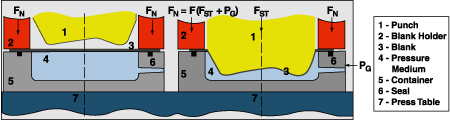
Figure 1: Sheet hydroforming diagram
The application of sheet hydroforming is expected to increase during the next decade. While the process has a disadvantage, namely the low cycle times, it offers many advantages for automotive applications. Some include:
References:
1. T. Nakagawa, K. Nakamura, and H. Amino, "Deep Drawing of Large Sheet Metal Parts With Hydraulic Counter Pressure," in K. Siegert, ed., Latest Developments in Sheet Metal Forming (DGM-Informationsgesellschaft Oberursel, 1988).
2. Schnupp GmbH & Co. Hydraulik KG, D-94327 Bogen, Germany.
3. P. Hein and F. Vollersten, "Hydroforming of Sheet Metal Pairs" Journal of Materials Processing Technology, Vol. 87 (1999), pp.154-164.
4. T. Altan, private communication.

Professor Emeritus and Director - Center for Precision Forming
The Fabricator is North America's leading magazine for the metal forming and fabricating industry. The magazine delivers the news, technical articles, and case histories that enable fabricators to do their jobs more efficiently. The Fabricator has served the industry since 1970.
start your free subscription



Easily access valuable industry resources now with full access to the digital edition of The Fabricator.

Easily access valuable industry resources now with full access to the digital edition of The Welder.
Easily access valuable industry resources now with full access to the digital edition of The Tube and Pipe Journal.
Easily access valuable industry resources now with full access to the digital edition of The Fabricator en Español.
In this episode of The Fabricator Podcast, Caleb Chamberlain, co-founder and CEO of OSH Cut, discusses his company’s...