




Exposition Marketing Manager

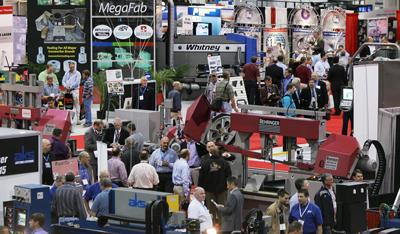
If you are a small-business owner, it's possible you have been shying away from spending money on tradeshows in this tight economy. Perhaps you view exhibiting as a luxury meant for better times, relying instead on your company's Web site and traditional telemarketing to promote and sell products. But exhibiting at events is probably the smartest thing your job shop can do, regardless of the state of the economy.
Tradeshows still play an important role in the business-to-business mix. They provide critical exposure to potential buyers and are essential to building personal relationships and getting a first-hand look at the competition. It's the one marketing tool, regardless of the industry, that can accelerate the sales process by delivering a high volume of interested, qualified, face-to-face interactions in a short period of time.
When you compare traditional methods for reaching customers and prospects with exhibiting, tradeshows take the lead. Taking time away from the shop is not always an option, and with travel and transportation costs rising, sending salespeople to prospect and visit customers is getting more expensive. On average, a salesperson can see two or maybe three people per day. In two and a half days, that would equal six people. In comparison, a 10- by 10-net-square-foot booth staffed with two people can average 12 interactions per hour (at about 10 minutes with each person). Multiply the 12 interactions per hour by the number of show hours. Let's say 28 hours is typical for a four-day event. That results in 560 face-to-face interactions.
The time and money spent to close a lead from a tradeshow is more cost-effective as well. The Center for Exhibition Industry Research reports that it takes an average of 1.6 personal sales calls to close a sale with an exhibition lead. Without an exhibition lead, 3.7 sales calls are needed because the prospect often has not met your salesperson, has not seen your product in use, and has not met your competition or seen their product in use. Research also shows the per-customer cost to close a sale by making contact at a tradeshow is 79 percent less than by other sales and marketing efforts.
Brendan Whistler, vice president, S.B. Whistler & Sons Inc., finds similar benefits to exhibiting. "Tradeshows are one of the few opportunities to have so many customers and potential customers under one roof. We have found that, although it can be costly to exhibit at tradeshows in general, it is still the least expensive way (per lead or inquiry) for us to get out, market, and try to touch as many clients as possible." Whistler added, "It only takes one good, qualified inquiry that can result in a new order or customer and therefore pays for the entire show." S.B. Whistler & Sons is a tool and die manufacturer in Medina, N.Y., that also provides contract manufacturing services.
Tradeshows dedicate a lot of time and money to marketing an event to make sure that the show floor is full of qualified attendees. If your marketing budget has been cut or is nonexistent, wouldn't it make sense to take part in an event that consolidates buyers all in one place, essentially bringing business directly to you?
In addition, shows typically provide a number of free marketing tools and speaking opportunities to help you promote your company's presence at the show, drive buyer traffic to your booth, and garner the attention of the news media. Below are a few examples of how you can market beyond your booth:
Tradeshows provide a great opportunity to connect with a large number of people in the same field, most of whom you would not normally encounter on a daily basis. Depending on the size of the event, attendance can range from a few hundred to tens of thousands.
Mark Rosenberg, sales manager at Ohio Laser LLC, explains the benefits that networking at tradeshows offer his company. "Shows provide us the ability to network with customers, prospects, vendors. They make the decision-makers easily available to us. Exhibiting at shows allows us to present our company and services to prospects we have not been able to penetrate." Rosenberg adds his analogy: "The more 'fishing lines' you place in the water, the more fish you will catch." Ohio Laser LLC, Plain City, Ohio, provides laser cutting and fabricating products and services.
Keep in mind that key connections extend to fellow exhibitors too. Networking at events provides not only the chance to exchange ideas, but also observe research trends to see where the market is headed, build on current relationships, and find new ones. Making effective business contacts in today's economic climate can be the difference between success and failure.
Before you do anything, spend some time doing research to determine which shows are likely to offer the best results for your company. Here are the five most important questions to ask:
1. Will the show attract the right prospects? Review the postshow report to find out how the previous event performed. Here you will find important data such as verified number of attendees and exhibitors; an audience profile including buyer influence, plans to purchase, and product interest; industry representation; buyer behavior such as role in buying; budgets; and exhibitor information such as total leads collected and average number of leads per exhibitor.
2. Is my competition at the event? Take a look at a past or current exhibitor list to see if competitors are listed. If your competition is there, it is a sure sign that the show produces the right results. If your competition is nowhere in sight and you have determined the prospects are good – their loss. Take advantage of this opportunity to get the lion's share of business.
3. What do exhibitors have to say about the event? Touch base with past exhibitors and buyers in your industry and ask them about their exhibiting experience. Hearing from industry peers is one of the best ways to get a pulse on the event's potential.
4. What is the cost? Things to consider include booth size, fees for shipping product or display, charges for drayage, and access to resources such as electricity. In addition, out-of-towners need to factor in lodging and food expenses. Be sure to take into account complimentary show marketing and services to get a complete picture of the value of exhibiting.
5. What is the event actually like? Register as an attendee and walk the show floor to get a feel for the event itself. Connect with other attendees and exhibitors, attend a conference, and listen to new-product presentations. Visiting the show will help you determine if your company needs to participate.
Is exhibiting at tradeshows necessary for a job shop to succeed? Perhaps not, but tradeshows are a valuable part of any successful marketing strategy. As long as companies understand that exhibiting goes beyond the giveaways, tradeshows add value. Setting up a booth and waiting for customers to show up is not going to work in today's business climate. By selecting the right show, clearly defining the reasons for attending, setting goals, implementing preshow and at-show marketing, committing to prompt postshow follow-up, and measuring success, your company will get the most out of exhibiting.
The Fabricator is North America's leading magazine for the metal forming and fabricating industry. The magazine delivers the news, technical articles, and case histories that enable fabricators to do their jobs more efficiently. The Fabricator has served the industry since 1970.
start your free subscription


Easily access valuable industry resources now with full access to the digital edition of The Fabricator.

Easily access valuable industry resources now with full access to the digital edition of The Welder.
Easily access valuable industry resources now with full access to the digital edition of The Tube and Pipe Journal.
Easily access valuable industry resources now with full access to the digital edition of The Fabricator en Español.
In this episode of The Fabricator Podcast, Caleb Chamberlain, co-founder and CEO of OSH Cut, discusses his company’s...