







Managing Director

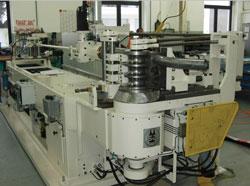
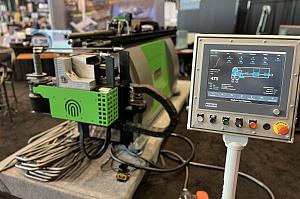
A smaller investment and adequate production capacity—the arguments for buying a second-hand machine are obvious. Is it that simple though? Particularly in the case of complex tube bending machines, many factors determine the efficiency of using a second-hand system. Beware that in the worst case, a second-hand machine can become a liability in the production sequence because the component quality and output performance do not match those of your existing equipment.
Who buys a used car without a test drive and without learning about its features? Investing in a second-hand system resembles this scenario more often than you would think. This can be especially troublesome if a complex bending machine from a niche area is bought without consulting the original manufacturer. In many cases, the machine is customer-specific, designed and built for high-precision bending results by means of CNC, high-performance drives, and complex bending tools. It’s not a simple matter to dismantle and reconstruct such a machine to produce new components.
It’s critical to learn what the bender was designed to do—the component geometry, material, and output quantity are three main factors. A machine designed to process thin-walled exhaust pipes in mass production might not be suitable for bending thick-walled high-pressure tubes for plant construction. The machine manufacturer is in the best position to determine if the machine’s design and drive concept can produce the intended components in sufficient volumes.
The buying and selling of second-hand, special-purpose machines, usually again and again without consulting the manufacturer, is the result of economic considerations. It’s difficult to walk away from a bender offered at an attractive price. However, buyers of bending machines frequently take excessive risks. Machines often are purchased without any testing. Under these conditions, it is impossible to verify that the system has the required capacity.
A thorough evaluation is necessary before making the purchase. The control must show no errors, the mechanics must not be worn, and the machine must be complete in terms of its components. Every axis must work properly.
However, this is just the minimum; many more aspects need to be evaluated. Even small things can tip the balance. For example, if incorrect hydraulic filters are used, the result is a problem in the hydraulic pumps after a short time.
Again, this evaluation is best carried out by the equipment manufacturer.
Sellers sometimes exploit uninformed buyers: old machines are repainted and, in some cases, the capabilities are exaggerated, and accordingly the machine is sold for an inflated price.
The manufacturer can look up the serial number to determine the details, such as the delivery condition, age, and whether the machine has undergone regular maintenance by the manufacturer.
A related problem concerns improper repairs. In the event of production problems, even the original manufacturer’s fitters are sometimes baffled, because they cannot repair nonstandard parts. It is a good idea to contact the manufacturer before making the decision to invest.
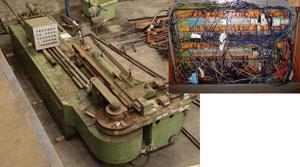
Purchasing a used machine has inherent risks. Wear and tear on machine components, outdated controls, misaligned components, improper repairs (see wiring, inset photograph), and its structural integrity are some of the many significant concerns. Even something less critical, such as the machine’s cleanness, can be a factor in pricing a used machine.
If the machine has been altered, restoring it to its original condition is possible only if all the original parts are still available. Generally, only the machine manufacturer can determine if vital components are still available. Here again, the manufacturer’s database has the necessary information.
Keep in mind that if the manufacturer reconditions the machine, it will replace all of the obsolete components. Moreover, a service contract provides a measure of assurance that the machine will have a sufficient service life.
Of course, these indicators aren’t a guarantee. The ideal way to purchase a second-hand machine is to buy it from the original manufacturer. Many equipment manufacturers provide reconditioned and factory-tested second-hand machines.
Reconditioning gives the manufacturer an opportunity to restore the machine to original condition by completely dismantling and reconstructing it from scratch, and including the latest control, electrical and electronic devices, hydraulics, and so on. It’s also an opportunity for the manufacturer to install the latest safety features. In the U.S., this means bringing the machine into compliance with the latest standards, such as the American National Standards Institute (ANSI); in Europe, the machine earns the CE mark. If the machine doesn’t display a CE marking and its safety technology is incomplete, it must not be operated. In some cases, even the lack of operating instructions might be enough for a second-hand machine to be out of compliance with the safety regulations.
You should also inquire about the machine’s warranty when considering a reconditioned machine.
Better Brand-new?
When should a second-hand machine be avoided? The product range and intended use of the machine are critical considerations.
A second-hand machine is a candidate if no series parts are to be produced and sufficient time is scheduled for maintenance and repair. On the other hand, if production is dependent on a high level of availability, and you want the advantages of the latest controls, a new or reconditioned machine is a better choice.
Resolving a handful of questions will go a long way in ensuring the machine is a good choice for the application, and that the machine will provide the necessary reliability and output.
Answering the following questions completely and accurately requires a machine evaluation by the manufacturer.


The Tube and Pipe Journal became the first magazine dedicated to serving the metal tube and pipe industry in 1990. Today, it remains the only North American publication devoted to this industry, and it has become the most trusted source of information for tube and pipe professionals.
start your free subscription


Easily access valuable industry resources now with full access to the digital edition of The Fabricator.

Easily access valuable industry resources now with full access to the digital edition of The Welder.
Easily access valuable industry resources now with full access to the digital edition of The Tube and Pipe Journal.
Easily access valuable industry resources now with full access to the digital edition of The Fabricator en Español.
In this episode of The Fabricator Podcast, Caleb Chamberlain, co-founder and CEO of OSH Cut, discusses his company’s...