










Professor Emeritus and Director - Center for Precision Forming

This column was prepared by Hyunok Kim, a staff member of the Engineering Research Center for Net Shape Manufacturing (ERC/NSM), The Ohio State University, Professor Taylan Altan, director.
Lubrication has a key role in the deep drawing and stamping of sheet metal parts, because lower friction increases the process window (see Figure 1), which can be characterized by the blank holder force, fbh, and the drawing ratio,b. forming complex-shaped aluminum panels in modern car bodies requires understanding the influence of the material properties and friction conditions on the deep-drawing performance.
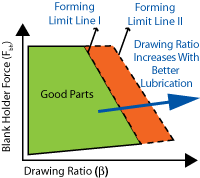 |
| Figure 1 Lubrication has a key role in the deep drawing and stamping of sheet metal parts, because lower friction increases the process window, which can be characterized by the blank holder force, Fbh, and the drawing ratio, . |
Recent studies have shown dry film lubricants provide better lubrication in deep drawing when compared with oil-based liquid lubrication. This factor, as well as savings in the amount of lubricant used, has helped promote the use of dry film lubricants in the automotive industry for stamping aluminum and high-strength steel parts. In fact, a new Mercedes S-Class model features an indoor engine hood drawn with dry film lubricants.
The deep-drawing test commonly is used to evaluate the performance of lubricants under production conditions. Sheet blanks coated with different lubricants are drawn with different blank holder forces until fracture occurs in the drawn part. The lubricant that allows fracture-free drawing with the largest blank holder force is selected to be the "best" lubricant.
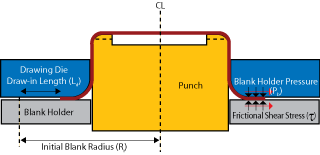 |
| Figure 2 Increasing blank holder pressure, Pb, allows more severe and sensitive friction conditions at the flange areas of a drawn part. |
As discussed in Part I, increasing blank holder pressure, Pb, allows more severe and sensitive friction conditions at the flange areas of a drawn part (see Figure 2).
Deep drawing as a lubricant evaluation test is being developed further at the Engineering Research Center for Net Shape Manufacturing using the following criteria:
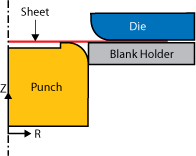 |
| Figure 3 The sheet blanks used for the deep-drawing test were 12 inches (304.8 millimeters) in diameter and 0.093 in. (2.35 mm) thick. |
Finite element (FE) simulations of deep drawing were conducted using the commercial software DEFORM 2D. The material properties of American Iron and Steel Institute (AISI) 1008 hot-rolled steel, determined by the viscous pressure bulge test under biaxial deformation conditions, were used for the FE simulations. The sheet blanks were 12 inches (304.8 millimeters) in diameter and 0.093 in. (2.35 mm) thick (see Figure 3).
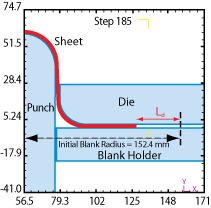 |
| Figure 4 The draw-in length, Ld, was calculated and compared with measured values. |
The draw-in length, Ld, was calculated and compared with measured values (see Figure 4). Two different values of friction coefficient, COF, were selected from general friction conditions in stamping and were used with two different blank holder forces, BHF, in FE simulations (see Figure 5).
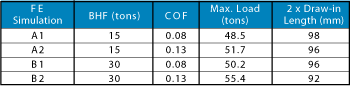 |
| Figure 5 Two different values of friction coefficient, COF, were selected from general friction conditions in stamping and were used with two different blank holder forces, BHF, in FE simulations. |
The preliminary FE simulations resulted in the following observations:
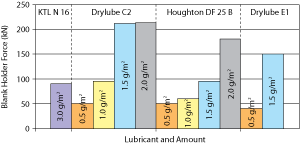 |
| Figure 6 The deep-drawing test also is helpful for optimizing the amount of dry film lubricant used. |
The deep-drawing test also is helpful for optimizing the amount of dry film lubricant used (see Figure 6).
The amount of dry film lubricant used usually is from 0.5 to 1.5 grams per square meter, depending on the severity of the drawing process. An excessive amount of dry film lubricant can cause problems not only in material handling, such as decoiling and destacking, but also in lubricant consistency during deep drawing. Furthermore, the excessive lubricant may accumulate on the die and need to be cleaned off periodically.
Taylan Altan is a professor and director of the Engineering Research Center for Net Shape Manufacturing, 339 Baker Systems, 1971 Neil Ave., Columbus, OH 43210, 614-292-9267, fax 614-292-7219, www.ercnsm.org. The ERC/NSM conducts research and development; educates students; and organizes workshops, tutorials, and conferences for the industry in stamping, tube hydroforming, forging, and machining.
References
G. Gutscher and T. Altan, "Flow Stress Determination Using the Viscous Pressure Bulge (VPB) Test," Journal of Materials Processing Technology, Vol. 146, Issue 1 (2004), pp. 1-7.
M. Meiler and H. Jaschke, "Lubrication of Aluminum Sheet Metal Within the Automotive Industry," Advanced Materials Research, Vol. 6-8 (2005), pp. 551-558.
M. Meiler, M. Pfestorf, M. Merklein, and M. Geiger, "Tribological Properties of Dry Film Lubricants in Aluminum Sheet Metal Forming," in proceedings from the 2nd ICTMP, Lyngby, Denmark, 2004.
M. Pfestorf, "Influence of Dry Film Lubricants and Surface Structure on the Forming Behavior of Aluminum Sheets," BMW Group, Mnchen, Germany, 2002.
S. Wagner, H. Kleinert, and R. Zimmermann, "Dry Film Lubricants for Sheet Metal Forming," in proceedings from New Developments in Sheet Forming International Conference, University of Stuttgart, Germany, 2002.

Professor Emeritus and Director - Center for Precision Forming
The Fabricator is North America's leading magazine for the metal forming and fabricating industry. The magazine delivers the news, technical articles, and case histories that enable fabricators to do their jobs more efficiently. The Fabricator has served the industry since 1970.
start your free subscription


Easily access valuable industry resources now with full access to the digital edition of The Fabricator.
Easily access valuable industry resources now with full access to the digital edition of The Welder.
Easily access valuable industry resources now with full access to the digital edition of The Tube and Pipe Journal.
Easily access valuable industry resources now with full access to the digital edition of The Fabricator en Español.
In this episode of The Fabricator Podcast, Caleb Chamberlain, co-founder and CEO of OSH Cut, discusses his company’s...