




Product Manager of Tube Bending & Fabricating

In today's economic atmosphere, manufacturers face many challenges. For example, if you fabricate tubular components, you probably realize that you can no longer win new business simply by having manually operated equipment ready and assuming that you can staff up with qualified operators and technicians on short notice. As is the case with manufacturers in nearly every subsector, you may have found that the key to staying competitive is some level of automation. Furthermore, the equipment must be adaptable, or flexible. Flexibility is the key to rapid production response today and manufacturing readiness tomorrow.
Automating with flexible equipment is necessary so the cell is useful for both current and future projects. The ability to change from one manufactured part to another quickly is key. Programmable equipment and quick-change capabilities are critical in building a processing cell that can manufacture a variety of parts.
Component manufacturing programs today do not last as long as programs in the past. A duration of three years or less is becoming the norm. A flexible, automated system provides a platform to handle several low-volume programs; allows changes from one program to another quickly and efficiently; and is programmable to accommodate new work in the future (see Figure 1).
Some of the reasons such a system may improve productivity are:
Tube fabricators are running into some new roadblocks in justifying equipment purchases. They might be prepared technically to automate a new project, but the part volumes usually are lower than in the past. Therefore, purchasing new capital equipment does not seem to make good business sense, at least when using financial models of days gone by.
For many, it's a matter of finding a new way to approach the justification process. An automated system can be assembled using existing equipment and purchasing used equipment. When the economy is slow, used equipment is more readily available than when the economy is growing briskly. The key is to evaluate the available equipment and your processes judiciously and automate the processes that provide the biggest bang for the buck.
Hopper/Loader. The first challenge is finding a tubular component hopper or loader that can be loaded easily (see Figure 2).
The hopper must have a weld seam detector. This will help position the tube properly to keep the weld seam away from pierce or punch locations. Consistent weld seam location also improves bend consistency. While the hopper most likely will be a new purchase, it may be the only new equipment required for the automation project.
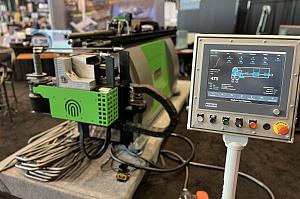
CNC Bender. CNC benders are the most versatile benders available. They can be programmed for the bend's degree, rotation, and position. Stacked tooling on the bend head allows the machine to bend more than one bend radius.
End Former. Most tubular components need some type of forming done to at least one of the ends. If you have an end former available, it would be a good addition to your processing cell.
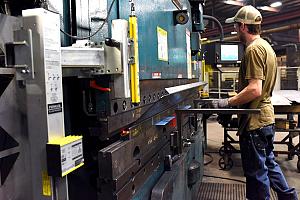
Hydraulic Press. A press rated at 70 tons can do most of the forming, flattening, and punching required for tubular components with diameters up to 1.5 inches. Keep in mind that the press isn't the only cost; you'll need to purchase dies for the parts that require forming and flattening.
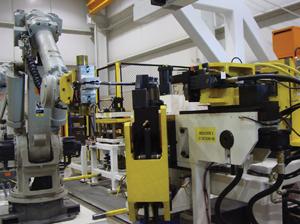
Robots. Take advantage of the flexibility that robotic technology offers. Robots are the most flexible automation devices available today. You don't need one robot per machine; a single robot can move the workpieces from one forming or processing module to the next (see Figure 3). Whether buying or redeploying, choose a robot that is serviced easily and has the necessary capabilities—reach and payload—for your applications.
All of the equipment described previously is flexible to some degree. The tube hopper is adjustable; the CNC bender and end former are fully programmable and have quick-change tooling; the hydraulic press can accept dies for a variety of forming applications; and the robot is programmable for an infinite variety of motions.
The cost for a system that comprises used or reconditioned equipment can be as little as one-third the cost of a new system. In addition to the current economic problems that plague our industries, low-cost competitors in developing countries are a constant and growing threat to our domestic manufacturing base. Many U.S. manufacturers must automate to remain competitive.
Perhaps the hybrid approach described here, a combination of new, used, and redeployed equipment, integrated with the help of an experienced system manufacturer or in coordination with your own engineering and technical team, can help your company stay competitive while meeting the challenges of the future.

The Tube and Pipe Journal became the first magazine dedicated to serving the metal tube and pipe industry in 1990. Today, it remains the only North American publication devoted to this industry, and it has become the most trusted source of information for tube and pipe professionals.
start your free subscription


Easily access valuable industry resources now with full access to the digital edition of The Fabricator.

Easily access valuable industry resources now with full access to the digital edition of The Welder.
Easily access valuable industry resources now with full access to the digital edition of The Tube and Pipe Journal.
Easily access valuable industry resources now with full access to the digital edition of The Fabricator en Español.
In this episode of The Fabricator Podcast, Caleb Chamberlain, co-founder and CEO of OSH Cut, discusses his company’s...