






Sales Manager

Editor's Note: This article is the second part of a two-part series about developments in orbital welding. Part I discusses power supplies, weld heads, and electrodes. Part II focuses on hardware and accessories that improve weld quality and software that documents the welds.
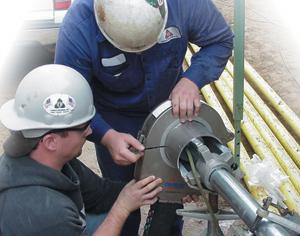 |
The growing use of orbital welding is driven mainly by enhancements it can offer to productivity, quality, consistency, traceability, and ease of use.
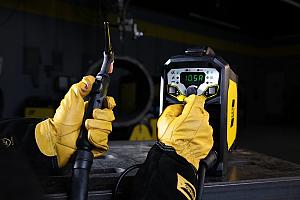
For the purpose of quality assurance, the ability to record a data log file is a standard feature on most state-of-the-art equipment.
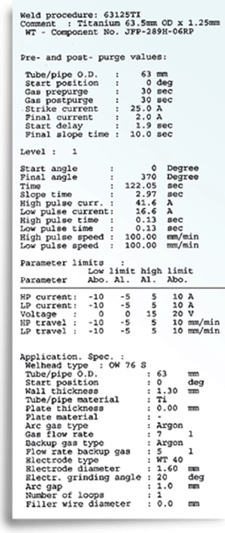 |
| Figure 1 Orbital welding machines can log gas type, gas flow rate, tungsten electrode type, tungsten electrode grind angle, and filler materials for each welding procedure. |
Processing plants usually ask contractors for weld mapping on pipework, and this is easier to control with modern equipment. A unique weld number is assigned to each weld made. Alternatively, accumulative data logging may be used. Each log file (see Figure 1) gives the date, time, weld number, comments, and real-time parameter details for easy referencing after completion of a contract.
Log files can be printed weld by weld or stored on a PC card and transferred to a PC for filing. It is becoming a common practice for contractors to store all procedures for an entire job and then copy the log files to a CD to present to the client when the contract is completed.
The machines contain not only weld schedules but full weld procedures. These include welding parameters and details about the application specification.
Most orbital welding applications require an inert gas. The gas, which surrounds the molten weld pool and the electrode during the welding process, prevents oxidation or contamination of the weld joint.
Several products are available to help control gas purity and minimize the amount of gas used. Maintaining strict control of the gas enhances the quality of the weld and conserves the purge gas.
For ultrahigh-purity (UHP) applications, gas filters can help supply a clean and pure gas to the weld area.
Other welding accessories localize the area of gas shielding around the weld joint. Gas analyzers let the operator know exactly when the weld cycle can begin and also help to guarantee that gas levels are within specification.
Some analyzers simply plug into the power supply and then take full control of the welding cycle. They can be set to send a signal to the power supply to start welding when the oxygen level is at a suitably low level. They also monitor the gas during welding and either sound an alarm or stop welding if the oxygen level rises too high.
A tube or pipe's end-use requirements—including mechanical, thermal, stability, and corrosion resistance—dictate material selection. Complex applications may require significant testing to ensure that the completed product meets life cycle objectives.
Different batches of the same material can have slightly different concentrations of alloying and trace elements. Trace elements can cause the conductivity and melting characteristics of each batch to vary.
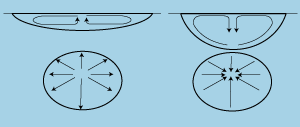 |
| Figure 2 Low sulfur content (0.001 to 0.008 percent) has a negative surface tension temperature coefficient, which results in a wide, shallow weld profile (left side of illustration). Normal sulfur content (0.009 to 0.030 percent) has a positive surface tension temperature coefficient, which results in a narrow, deep weld profile. |
Minor variations in the amounts of sulfur can have a dramatic effect on the fluid flow in the weld pool, changing the weld profile and causing the arc to wander (see Figure 2). These variations also affect the amount of penetration, a phenomenon called the Marangoni effect.
When operators change from one batch of material to the next, it is important that they make a test coupon for the new batch. As in manual welding, a minor amperage adjustment usually is required to return the weld to its original profile.
Weld joint fit-up depends on specification requirements for tube straightness and acceptable weld concavity, reinforcement, and drop-through. If no specification is stated, the laws of physics dictate the molten material flow and compensate for tube mismatch and any gap in the joint.
Tubing is produced according to tolerances that are tight or loose depending on the tube's end use. It is important that the wall thickness is consistent at the weld joint from part to part. Differences in tube diameter or out-of-roundness will cause weld joint mismatch and arc gap variations from one welding setup to another.
Some tube preparation machines can produce a perfectly square end with burr-free inside and outside surfaces ready for orbital welding. This equipment is essential in applications that require weld joint repeatability.
When two tubes are butted together for welding, two main considerations are mismatch and gaps. In general, the following rules apply:
While orbital welding equipment cannot perform every welding job or replace skilled welders, it fills a niche in the welding industry and helps to ease the shortage of qualified welders. As technology advances and equipment and software become more sophisticated, orbital welding will continue to improve in productivity, quality, and consistency.

The Tube and Pipe Journal became the first magazine dedicated to serving the metal tube and pipe industry in 1990. Today, it remains the only North American publication devoted to this industry, and it has become the most trusted source of information for tube and pipe professionals.
start your free subscription



Easily access valuable industry resources now with full access to the digital edition of The Fabricator.

Easily access valuable industry resources now with full access to the digital edition of The Welder.

Easily access valuable industry resources now with full access to the digital edition of The Tube and Pipe Journal.

Easily access valuable industry resources now with full access to the digital edition of The Fabricator en Español.
In this episode of The Fabricator Podcast, Caleb Chamberlain, co-founder and CEO of OSH Cut, discusses his company’s...