














Flushing out four-letter words: rust, dirt, and wear (Part II)
Removing soils effectively
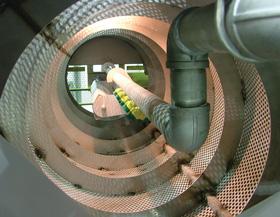 |
| A tubular assembly is cleaned in an Alliance Aquamaster CD-3000 rotary-drum cleaning system with wash and heated blowoff. The drum is constructed of stainless steel and includes spiral flights and part "kicker" bars. Photo courtesy of Alliance Manufacturing Inc., Fond du Lac, Wis. |
This article is Part II of a multipart series that addresses how to eliminate tube producing and fabricating problems. Part II addresses the use of cleaners. Part I, which appeared in the April/May issue, discussed how to select a rust inhibitor. Click here to read the Troubleshooting Guide for Cleaners.
Tube producing, cutoff, and deburring operations incorporate cleaning as a vital step in the manufacturing process. The reason for this is that chemicals such as lubricants and rust preventives that are needed during tube producing and metal fines may need to be removed afterward. If they are not removed, they can cause problems in the form of stickiness, tarnishing, corrosion, pitting, and nonuniform surface finish. Most tube producers remove these compounds as they prepare the tube or pipe for in-process storage or for postprocessing operations such as assembly, painting, plating, rustproofing, or welding.
Four common categories of products are used for most cleaning operations. Each of these cleaners exhibits different cleaning characteristics:
1. Alkaline cleaners have a pH solution above 7.0. They are used primarily to remove organic soils such as oils, greases, and fats. They are used commonly in industrial manufacturing plants because of their broad cleaning capabilities, excellent detergency, and low cost.
2. Acids have a pH solution below 7.0 They are used primarily to remove rust, tarnish, and oxide films.
3. Solvents dissolve organic soils. Environmental regulations, newer technologies, and cost have restricted the widespread use of these products.
4. Emulsion cleaners could fall in the general class of solvent cleaners, but because of their function and performance, they are considered a separate category. They flush away soils and oils from processed tube and pipe and can provide a barrier film with excellent rust protection.
Metal cleaners vary greatly, depending on the function of the cleaner and the cleanness standards required. Answering the following questions will facilitate the selection of the proper cleaner.
1. What will the solution remove? Soluble coolants? Straight oils? Grease? Understanding what is being removed optimizes the cleaning process.
Synthetic lubricants and coolants are surfactant-based, and as such can significantly increase foam levels. Therefore, the cleaner must exhibit excellent defoaming characteristics. If you change your lubricant or coolant and suddenly experience high levels of foam, you may need to change the cleaner as well. The good news is that these newer-technology lubricants and coolants generally are easier to remove than traditional straight oils and some soluble oils.
Often a dual-purpose cleaner—a bending lubricant or cutting fluid that also cleans—is recommended.
2. Are any special features needed for downstream operations? The cleaner must be suitable for postprocess operations. Understanding downstream fabrication or end-use requirements before using a cleaner will ensure smooth integration. For example, if the tube or pipe is to be used in a low-chloride environment, that cleaner should contain deionized water, preferably.
3. What is the composition of the tube or pipe? Knowing the metal composition of the tube or pipe to be cleaned and how the metal reacts with certain chemicals will help prevent adverse reactions. For example, a caustic cleaner that is not inhibited may pit or discolor aluminum.
The cleaner must be compatible with all of the metals cleaned. In some cases, a cleaner that is safe for use on a variety of metals can reduce the number of cleaners needed.
4. Are there any restrictions on ingredients? In the electronics industry, for example, caustic ingredients may be undesirable. It is important to understand what the restrictions are, not only for the tube being processed, but also for waste treatment purposes.
5. What degree of cleanness is required? Understanding the cleanness requirements for the tube or pipe will determine an appropriate cleaner. Cleaners used for simple, noncritical applications differ from those used for specialty applications. A highly specialized cleaner that may be used to clean nuclear fuel cells likely would not be required for tubes used in an automotive application.
Cleaning requirements are generally categorized as:
- Visual only
- Not oily to the touch
- No water breaks
- Other or no specific requirement
6. How will the cleaner be applied?
- Immersion. Tubes or pipes are im-mersed in a cleaner solution in traditional dunk tanks or ultrasonic baths. This method is suitable for long tubes.
- Power spray washers. Generally, tubes are placed on a belt and proceed through stages. In power spray cabinet washers, parts are stationary and spray is aimed directly at them. This method typically is suitable for short tube sections.
- Rotary. Spinning action and part-on-part contact action facilitate cleaning action, similar to the way clothes are cleaned in a home laundry machine. This process is rarely used on tubes.
- Manual. Manual cleaning operations may be done on specialty applications or when the capital required to purchase an automated washer is not available.
7. If an immersion bath is used, how often is it changed? The bath life of an immersion cleaner varies, depending on usage. Lab tests can offer some indication, but the most accurate method of determining bath life is to monitor the level of cleanness of the tubes at they are processed.
8. What form of cleaner is desired? Cleaners can be manufactured in either powder or liquid form. While powders may be less costly, water-based cleaners generally are more convenient to use and more commonly accepted in the industry.
9. Will the cleaner be used cold or heated? Many cleaners need to be heated to activate certain components and to reduce foam. Heat is a major component of soil removal. While recent advances have improved the detergency of cleaners, heat improves the cleaner's efficiency.
10. What are the concentration and temperature parameters? These parameters play vital roles in a cleaning operation's success or failure. If the concentration is too low, the parts may not be cleaned effectively. Inversely, if it is too high, the residual film may cause spotting or streaking. Excessive heat may deteriorate certain components of the cleaner's formulation. A too-low temperature may inhibit good cleaning and create foam. Newer cleaners use components designed to reduce foaming while they operate at lower temperatures, resulting in energy savings.
11. How hard is the water? Additives can be incorporated into cleaners to reduce hard water spots. Impurities in water, such as calcium and magnesium salts, impair the performance of alkaline cleaning solutions by forming insoluble compounds with soaps and other active ingredients.
12. Will the cleaner be expected to provide temporary rust protection? If the tube is rinsed and a temporary rust preventive is applied, the rust protection capability of the cleaner is not a primary function. If rust protection is a vital component, it is important to understand how much protection is required. However, recent advances in additive technology have given cleaning compounds the versatility of removing difficult soils while allowing residual films to provide excellent rust protection.
13. How will the tube or pipe be handled after cleaning? The type of rust protection that is required and other materials the tube will come in contact with affect cleaner selection.
- If the tubes will be deposited randomly in bins or baskets, it is best if the parts are as dry as possible.
- If the metals are ferrous, the cleaner should have rust preventive capabilities.
- If the tubes are stacked or nested tightly, they should be dry to prevent sticking together, and residual film should be minimal to reduce the adhesive effect.
- If the tube goes directly to a paint line or assembly, the cleaner's residual film should be compatible with the paint system or pretreatment systems.
- If the tube is plastic-wrapped or boxed, the container should be dry to prevent moisture entrapment. Cardboard can be acidic; if the cardboard boxes are not coated or treated with a rust preventive, the cleaner should contain one. Moisture can condense on plastic coverings as the temperature changes. If the plastic is not treated with a rust preventive coating, and moisture condenses on the plastic and drips onto the tubes, the cleaner must exhibit excellent rust-inhibiting qualities. In some instances, the tube may need to be treated with a secondary rust inhibitor.
14. Is the current cleaner causing any problems? Such problems can be in the form of rust, foam, poor bath life, poor cleaning performance, streaking, and spotting. Tube producers commonly experience problems with defoamers. While they are temporarily effective, defoamers are expensive and generally mask a deficiency in the cleaner.
15. What is the desired price range? Many surfactant-based cleaners can be costly. A lower-cost cleaner may satisfy the requirements.
Once these questions have been answered, an appropriate cleaner can be selected. In addition, it is advisable to evaluate the cleaner in a small-scale lab process.
Mike Pelham is strategic planner, International Chemical Co., Metalworking Lubricants, Cleaners & Rust Preventives, 2628-48 N. Mascher St., Philadelphia, PA 19133, 215-739-2313, fax 215-423-7171, mpelham@e-icc.com, www.e-icc.com.
About the Author
About the Publication


subscribe now
The Tube and Pipe Journal became the first magazine dedicated to serving the metal tube and pipe industry in 1990. Today, it remains the only North American publication devoted to this industry, and it has become the most trusted source of information for tube and pipe professionals.
start your free subscription- Stay connected from anywhere

Easily access valuable industry resources now with full access to the digital edition of The Fabricator.

Easily access valuable industry resources now with full access to the digital edition of The Welder.

Easily access valuable industry resources now with full access to the digital edition of The Tube and Pipe Journal.

Easily access valuable industry resources now with full access to the digital edition of The Fabricator en Español.
- Podcasting

In this episode of The Fabricator Podcast, Caleb Chamberlain, co-founder and CEO of OSH Cut, discusses his company’s...
- Trending Articles
1
Team Industries names director of advanced technology and manufacturing

2
3D laser tube cutting system available in 3, 4, or 5 kW

3
Corrosion-inhibiting coating can be peeled off after use
4
Zekelman Industries to invest $120 million in Arkansas expansion

5
Brushless copper tubing cutter adjusts to ODs up to 2-1/8 in.