










Contributing Writer

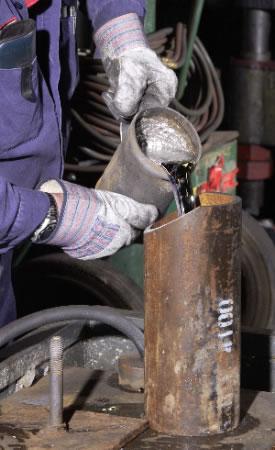
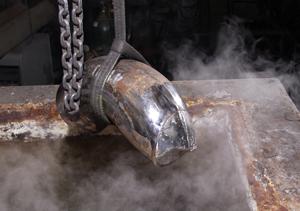
A low-melting-point alloy is heated and poured into a length of tube.
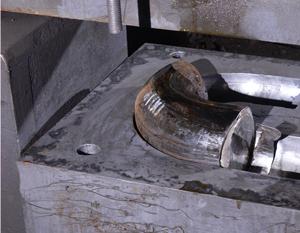
To reduce weight and cost for all types of products, design engineers often specify tubes and pipes with thinner walls instead of the previously used heavier-walled tubes and pipes. Shorter tube or pipe lengths also achieve the same objectives, but usually they require sharper or more complex bends (see Figure 1). These designs make the tube bender's task more difficult.
The use of a recyclable low-melting-point alloy as a mandrel may be helpful in achieving these more difficult configurations. Low-melting-point alloys have the advantage of conforming to any tube or pipe diameter, as well as any irregular shape, because they expand upon cooling rather than shrink. Because the alloys completely fill the tube or pipe during bending, the tube can be bent smoothly without kinking or wrinkling.
One low-melting-point alloy traditionally used to bend tube and pipe up to 2½ inches in diameter melts at 158 degrees F. A stronger alloy that melts at 255 degrees F is used for larger-diameter tube and pipe. The recent addition of a special grain refiner causes them to solidify, or freeze, with a close-packed, fine grain structure, which strengthens the alloy. Although the 158-degree alloy is recommended for bending tube and pipe less than 2½ in. in diameter, this strengthening characteristic does make it possible to use this alloy on diameters somewhat larger than 2½ in.
The 158-degree alloy is safer to use than the 255-degree grade, because it can be melted out of the tube or pipe in a hot water bath, so less costly release agents can be used with it.
The following steps are recommended for bending tube and pipe up to 2½ in. in diameter:
Prep
Install the mandrel
Bend the tube
This method also may be used for tubes larger than 2½ in. diameter, but care should be taken when following steps 1 through 10 to bend the tube only partially into its final shape. Then, after performing step 11, steps 1 through 10 should be repeated until the desired shape is attained, finishing the process with steps 11 and 12. A more convenient method for bending tube and pipe larger than 2½ in. diameter is discussed next.
Prep
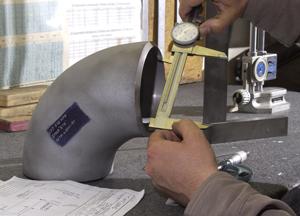
Figure 1. Using a low-melting-point alloy as a mandrel can achieve a satisfactory bend even when the bending parameters are demanding, such as sharp or complex bends or bending short lengths of tube.
Install the mandrel
Bend the tube
Rolled or extruded solid shapes also can be bent and formed using the same basic procedure, except that the entire form is encapsulated in a solid block of TBA. Leaving the formed sections in the TBA block for several hours will minimize springback.
When melting and holding the 158-degree-F alloy, using a cover of 1 in. or more of water will prevent the metal from oxidizing and causing metal loss and possibly casting problems. If the local water is hard (basic), it is important that the water be acidified slightly. Acetic acid (white vinegar) normally is the safest and most cost-effective way to acidify the water, resulting in a clean, shiny metal bath.
If the tube bending alloy is properly handled, very little loss of the alloy should occur as it is melted, poured into the tube, remelted, and poured out of the tube. It is possible that prolonged reuse will cause the melting point of the alloy to increase. If this does occur, the alloy manufacturer usually can restore the alloy to the proper melting point by refining or adding missing elements.

The Tube and Pipe Journal became the first magazine dedicated to serving the metal tube and pipe industry in 1990. Today, it remains the only North American publication devoted to this industry, and it has become the most trusted source of information for tube and pipe professionals.
start your free subscription


Easily access valuable industry resources now with full access to the digital edition of The Fabricator.

Easily access valuable industry resources now with full access to the digital edition of The Welder.
Easily access valuable industry resources now with full access to the digital edition of The Tube and Pipe Journal.
Easily access valuable industry resources now with full access to the digital edition of The Fabricator en Español.
In this episode of The Fabricator Podcast, Caleb Chamberlain, co-founder and CEO of OSH Cut, discusses his company’s...