







President

The foreman gives everyone the production schedule, and the last of the big order you were working on before the Friday shutdown is ready to run. Who's that on the phone? Oh, it's your No. 1 customer. He gave you a break on the delivery of the last three truckloads, but he isn't cutting you any more slack -- he needs his order NOW!
The mill starts up, but before it gets up to speed, you hear a rumble and a grinding sound from the driveline. It gets nothing but louder, and the No. 1 mill drive amp meter goes off the scale.
You have just been introduced to a real-life lesson in bearing failure. Bearings make the operation of the tube mill possible or, in this case, impossible.
The bearings in every tube mill, cutoff, and material handling system require constant care. Ignoring them leads to catastrophic failure.
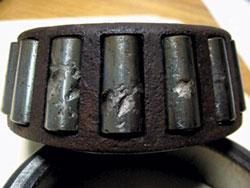 |
| Spalling, or breakdown, of a bearing’s tapered rollers can be caused by excessive loading or improper lubrication. |
The original bearing selection for each piece of equipment is based on a designer's grasp of the operating conditions and the minimum desired life expectancy for the application. In an industrial machine such as a welded tube mill, the minimum design life would be more than 3,000 hours, based on the worst-case loading and speed.
Each machinery supplier has a different design parameter based on the intended use and the supplier's experience. While a 3,000-hour life may sound short, it's based on the worst-case loading and related safety overload factors. Such circumstances include 24/7 operation, maximum material thickness and yield strength, maximum thickness-to-diameter (t/D) ratio, shock load of 2, maximum roll throat, maximum speed, and a safety factor.
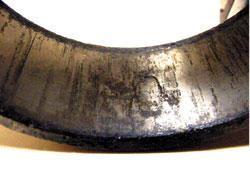 |
| Pitting or erosion of the mating bearing cup can result from excessive loading or improper lubrication. |
Normally, a 3,000-hour minimum life translates to many years of operation at normal load and speed because the equipment is seldom, if ever, operated anywhere near its maximum capacity.
Bearings and the related mechanical support systems are designed for the intended application and anticipated overload conditions. Premature bearing failures result when bearing mounting conditions or operating practices create unintended loading. Most existing designs for welded tube and pipe mills are time-proven but might still exhibit bearing failures caused by improper assembly, lubrication, and routine maintenance.
Design parameters and actual operating conditions notwithstanding, all bearings ultimately will fail. Your job is to prevent premature failure.
More often than not, the main reason for a bearing failure is not that someone forgot to do something, but that someone changed something.
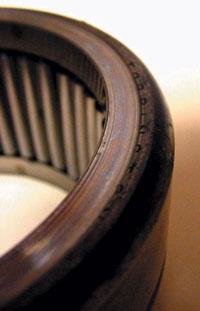 |
| Side thrust wear on an outboard needle bearing can result from improper assembly. |
For example:
Change is a necessary part of any operation. Your employees -- the most flexible part of the production process -- can and do learn new tricks every day. The bearings in your production equipment, however, can't adapt. Bearings have fixed operating parameters and can be downright stubborn about taking on new challenges.
Want to avoid the pain? Then confront the challenge of change with enthusiastic good humor and a better backup plan. Amassing knowledge is the key to developing your backup plan.
If you are new to the industry, then I recommend you look into TUBE U®, a basic training course offered by the Tube & Pipe Association, International® (TPA). This course was designed to provide a broad knowledge base for welded tube production. The course, available at www.thefabricator. com, focuses on common factors encountered in producing 3-in.-diameter and smaller welded tube.
Understanding the operational capabilities of your equipment is the next step in knowing if you can take on a new challenge. Contact the manufacturers of your existing equipment and ask if the machines can handle the new process parameters. Their experience and knowledge of what other customers have tackled successfully can be a lifesaver. Ask for the names of other companies that are doing what you want to try. Firsthand knowledge can't be beat.
The manufacturer might refer you to a competitor. Don't let that stop you. The exchange of basic information is a two-way street that usually has a payoff for both parties. One way to make these connections with other people in the industry is to attend tradeshows and technical conferences. Meet and get to know your counterparts and the vendors who supply equipment to the industry. In short, network!
The third approach to the problem occurs after something breaks. Here your recourse is first to contact the manufacturer of the equipment and second to contact bearing suppliers.
The mill manufacturer most likely will lend assistance. If this fails, you still have many other choices. A result of uncovering the problem is that you will be better prepared for the next challenge and will, in the end, learn more than just the replacement part number for the bearing.
Some simple rules can help determine the cause of a failure or the possible consequence of a change in operation for a typical welded tube mill. In these statements the term load means the radial capacity or thrust-carrying capacity of a bearing.
The bending resistance of material generates separating force. The major result is to push the tooling and the roll shafts apart, or to separate them. Torsional force, which is caused by the material's forming resistance as it moves through the roll tooling, provides an additional pulling force opposite to the direction of material flow.
Answers to your questions are available. Some additional resources are:

The Tube and Pipe Journal became the first magazine dedicated to serving the metal tube and pipe industry in 1990. Today, it remains the only North American publication devoted to this industry, and it has become the most trusted source of information for tube and pipe professionals.
start your free subscription


Easily access valuable industry resources now with full access to the digital edition of The Fabricator.

Easily access valuable industry resources now with full access to the digital edition of The Welder.
Easily access valuable industry resources now with full access to the digital edition of The Tube and Pipe Journal.

Easily access valuable industry resources now with full access to the digital edition of The Fabricator en Español.
In this episode of The Fabricator Podcast, Caleb Chamberlain, co-founder and CEO of OSH Cut, discusses his company’s...