









President

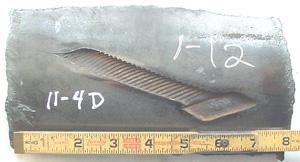 |
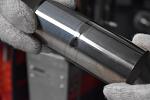
| This sample was cut from a section of welded 16-in.-OD pipe. The interesting pattern was created when a socket head cap screw got rolled into the strip at the steel mill.Photo provided by William C. Tungate, department manager, 16-inch mill, Newport Steel, Newport, Ky. |
Well, we've come around to another year. How can we make 2006 better than 2005? Mainly by not doing everything the same way we did it last year. It really is time to adopt New Year's resolutions like you mean it. I don't mean the ones about losing weight or getting that hair transplant or tummy tuck! I want to talk about the real you! What is it that really burned you last year? I don't know about you, but incompetence seems to rise to the top of the list again for me. Here are some examples:
Everyone knows the three rules of real estate ("Location, location, location"); the statement stands without explanation. A similar mantra should apply in any business: "Ethics, ethics, ethics." Ethical practices are paramount for success in any business and are crucial for everyone—suppliers, customers, managers, coworkers. One thing is sure: If ethics aren't the first concern, none of us can succeed.
You get the picture. These are, in my opinion, the top five underlying reasons for defeat in our industry. Defeat is a condition and a mental state; none of us works to our best potential when our self-image is one of defeat. I am sure you have your own list of reasons. I want to hear them and see them and share them. After all, one person can't wage the entire fight against the unseen, the unheard, the unspoken. We have much to be proud of, much to crow about. Consider this monthly article as a way to share both your defeats, if they would be a good lesson for others, and your triumphs, as they may spur others to try harder.
Let's start off with the fourth item on the list, the one we all love to hate—problematic material.
Your setup is right on ... the weld seam is rock-solid all the way through the line at the 12 o'clock position ... no weld faults ... the nondestructive and destructive test results are great, until you put the last coil on the mill. How come everyone wants to blame production when welds split? How come it is always someone's fault other than the raw material supplier's?
The flaw shown in the photo on the previous page was detected in inspection after welding. Some explanations are:
So here is your first challenge: Send me your quick, glib response to the complaint and we will publish it with recognition (unless you want to remain anonymous). The winner will receive a free coffee cup from the Tube & Pipe Association, International®.
Naturally, there is a serious side to this problem. The bottom line is that most material-related faults aren't discovered until after the tube or pipe is made.

The Tube and Pipe Journal became the first magazine dedicated to serving the metal tube and pipe industry in 1990. Today, it remains the only North American publication devoted to this industry, and it has become the most trusted source of information for tube and pipe professionals.
start your free subscription



Easily access valuable industry resources now with full access to the digital edition of The Fabricator.

Easily access valuable industry resources now with full access to the digital edition of The Welder.

Easily access valuable industry resources now with full access to the digital edition of The Tube and Pipe Journal.

Easily access valuable industry resources now with full access to the digital edition of The Fabricator en Español.
In this episode of The Fabricator Podcast, Caleb Chamberlain, co-founder and CEO of OSH Cut, discusses his company’s...