






















The future of vocational education
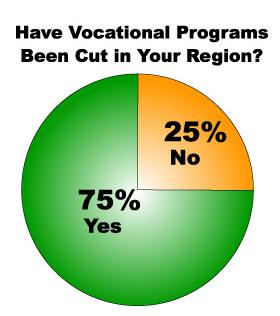 |
Many of those who responded that programs are still intact expressed concern that they may be cut in the near future.
A Major Issue
A recent article by Marty Rice, a welding instructor concerned about the growing trend to cut vocational and technical programs and the rumors circulating that President Bush plans to eliminate funding for the Perkins Act in the 2004 budget, inspired the question.
In his article, Rice stated, "My professional opinion is that cutting vocational programs is a bunch of bunk, as we say in Texas. Shut down vocational education and watch the dropout rate and skilled labor shortage rise! Recently a shipyard had to go to Ireland and India in search of welders. A decrease in craftsmen and -women in all of the construction trades is projected. Who the heck will build the buildings, planes, trains, and automobiles?"
The Threat to the Perkins Act
The Carl D. Perkins Vocational and Technical Education Act of 1998 provides funding for secondary and postsecondary vocational education programs from 1998 to 2003, covering program years July 1, 1999, through June 30, 2004. As stated in the act, "The purpose of this act is to develop more fully the academic, vocational, and technical skills of secondary students and postsecondary students who elect to enroll in vocation and technical education programs."
A legislative alert issued in November 2002 by the Association for Career and Technical Education (ACTE) stated that reliable sources have indicated that the president's budget proposal to Congress early next year would eliminate funding for the Perkins Act and use the budget allocation to offset a shortfall that exists in the Pell Grant program, a federal initiative to help the lowest-income students pursue postsecondary career and technical education as well as other postsecondary programs. The ACTE supports the Pell Grant program, but not at the expense of the Perkins funding.
A related concern is the possible transfer of all Office of Vocational and Adult Education (OVAE) functions to the Department of Labor (DOL), a move that many believe would result in a focus on training versus a more comprehensive education.
According to the ACTE, decisions on the proposal will be made by December, and action is needed now to prevent the elimination of the Perkins Act. Other national and state organizations have issued similar alerts and calls to action.
Yes, Vocational Programs Have Been Cut
Thefabricator.com readers told us much more than whether vocational programs in their areas had been cut—they told us what the cuts meant to them, to the country's youth, and to the industry. One of the most poignant responses came from a mother, who wrote,
- My son is a high school dropout. He is one test from getting his GED, but there currently are no programs in our area, unless you want to be locked up (Job Corps through prison) or you want to pay $3,600 (junior college, pay upfront, limited capacity for students, and only with a high school diploma). Job Corps programs are being cut back, and two curriculums have been slashed. He has no money, no prospects, and no future.
- [If a vocational opportunity had been available earlier], he would have jumped at the chance to learn hands-on manufacturing, die, and fabrications skills. He wants to get a job with our company when he turns 18, but with limited skills, he may not be able to get in the door.
Vocational instructors and individuals who serve on educational advisory boards told us what they've experienced:
"I will be laid off July 1 from the vocational educational technical system in the state of Connecticut. I have been an instructor for 26 years in the Metal Trades Technology Dept. Our focus has been fabrication with a strong lead program of welding. With the budget crisis in Connecticut, the adult programs, excluding nursing, will be closed as of July 1."
"Being a member of several advisory boards at our local technical school, I find it disgusting that the school, while chanting the need for teamwork and partnership with industry, will turn right around and cut needed curriculum. This has been an ongoing problem for many years. Schooling has become a business, the bottom line being the almighty dollar. What we need are schools that champion the quality of humanity through education as the bottom line."
More Than a Money Issue
Several readers gave reasons other than lack of funds for cutting programs:
"Unfortunately, in north central Ohio, the cutbacks have been fueled by low enrollments as much, if not more than, funding!"
"Programs have been cut as a direct result of a lack of job opportunities, specifically welding. This should be of concern to all of us. The true source of all wealth is in manufacturing, and when this goes, our country's prosperity is soon to follow."
Declining Enrollment
Are enrollments in existing programs declining? If so, why? C.J. Carlson, a welding instructor for the past nine years at the Homer S. Gudelsky Institute for Technical Education at Montgomery College, Rockville, Md., described a situation that substantiates this claim.
- When I started at MC in the spring of 1994, I was a midterm replacement instructor for the welding fundamentals course. This course was for third-year apprenticeship students who were in various trades. We had five students, one Miller Shop Master, and three sets of oxyacetylene torches. Through the years, enrollment grew and peaked at 14 students. But now the spring class that just ended had two students, even though we now have 11 welding machines, seven sets of torches, a plasma cutter, two horizontal band saws, five bench grinders, and many other frequently used hand and power tools. Boy o' boy we just got a new 260-lb. double-horn anvil!
Because of the low enrollment, next spring's session will be the last for Carlson's welding class. And after all of the current daytime students matriculate, the entire training program will end.
Image Problem
Readers suggest declining enrollment is due to several factors: the previously mentioned lack of job opportunities and the failure of school systems to encourage students to pursue vocational and technical education. Others cite the long-standing image problem associated with the trades.
- Our programs are intact; however, the students are treated like second-class citizens. The perception of the students not attending the schools is that those who do are the ones who can't cut it in college or are troublemakers. I was on the board for [a vocational school], and found that high school guidance counselors push all the students to go to college. College isn't for everyone, and just because one doesn't go, does not mean that person is anything less than one who did.
- I am a tool- and diemaker by trade and went through an apprenticeship program that, in my opinion, rivals many college courses with regard to preparing one for the work force. I took advanced courses in design and hydraulics and went on to become engineering manager of several companies I worked for, as well as became operations manager of one of them.
Job Shortage
What about the lack of job opportunities? Yes, businesses have cut back as a result of the economic crisis. But a shortage of skilled labor remains, a shortage that will become even more critical once recovery begins—particularly if training opportunities go away. Impending Crisis – Too Many Jobs, Too Few Peopleby Roger Herman and Joyce Gioia discusses the anticipated crisis. The authors speculate that once the recovery begins, the labor shortage "will make the tight labor market of the late 1990s look like a practice session."
Stephen J. Martelli, a reader from Maine, recognizes the skilled labor shortage and is doing something about it.
- The need for qualified, skilled, and well-trained tradespeople in the state of Maine is dire. There simply are not enough to go around. As of December '02, we are in need of 20,000 trained craftspeople.
- My area of expertise is in welding and ironwork. I started out as a welder in 1975 and progressed to owning my own shop. I sold the shop and became a certified welding inspector and educator five years ago. Now I'm on the job, showing the younger welders their mistakes and how to correct them. At the same time, I am putting together a welding school that will educate people in welding, safety, scaffolding, and ironwork. The school is needed, and the construction industry has given me its blessing for opening this door to the future.
- The welder of the future must be smarter and more educated than ever before. In the past you could learn in your garage and get away with it. Today's welder needs to know about metallurgy, mathematics, and the basics at a higher level than was taught in the past.
A Student's Perspective
Hubert Nickisch, who just completed his first semester in the Kern County Regional Occupational Program (ROP) in Mojave, Calif., had nothing but praise for the program.
- On May 22 I completed my first semester in the Kern Co. ROP under the instruction of Michael Vanvakaris, who is a great inspiration to his students. The fate of our welding class is unknown at this time, and we all are hoping to return in September. Although I have no immediate plans for my newly acquired skills due to my present job, I hope to continue my education in metallurgy. However, the program is important to the other students. Michael goes out of his way to find jobs for his students through contacts in the field. He has a true passion for welding and the success of his students.
- I hope that people will respond to the California Legislators to preserve the ROP, which is vital to the community.
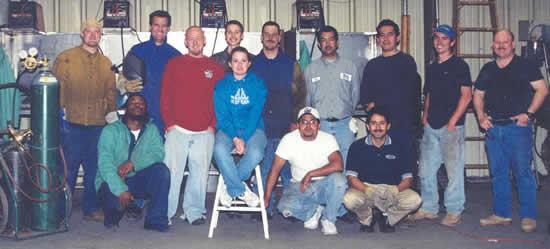 |
| Kern County ROP welding class. Hubert Nickisch is on the far right. |
What You Can Do
If you are concerned about the fate of vocational and technical education programs and want to make your feelings known to your congressional representatives, go to www.acteonline.org/policy/index.cfm. According to the ACTE Web site, there you will find an online tool that you can use to write your letter, print it to send by fax, or e-mail it to specific members of Congress. Simply enter your zip code in the box under "Action Alert" to receive contact information for your representative in Congress, and you are ready to write and edit your letter or e-mail. A sample letter is provided under "Action Alert" that addresses the issues. For your convenience, the ACTE has included a list of key Republican leaders in Congress for you to target.
Beyond Funding
While the collective efforts of those who strongly support the funding may save the Perkins Act and technical programs, other issues still must be addressed. The industry in conjunction with education must find ways to make the trades and training more attractive to young people.
About the Author

About the Publication

subscribe now

The Fabricator is North America's leading magazine for the metal forming and fabricating industry. The magazine delivers the news, technical articles, and case histories that enable fabricators to do their jobs more efficiently. The Fabricator has served the industry since 1970.
start your free subscription- Stay connected from anywhere

Easily access valuable industry resources now with full access to the digital edition of The Fabricator.

Easily access valuable industry resources now with full access to the digital edition of The Welder.

Easily access valuable industry resources now with full access to the digital edition of The Tube and Pipe Journal.

Easily access valuable industry resources now with full access to the digital edition of The Fabricator en Español.
- Podcasting

Seth Feldman of Iowa-based Wertzbaugher Services joins The Fabricator Podcast to offer his take as a Gen Zer...