
















|
|
Attempting to defy the laws of physics, Part IIIt is almost unrealistic to expect some stamped part part features, such as hole position and flatness, to remain within a small tolerancing zone.
Publish date: May 10, 2011 |
|
|
Attempting to defy the laws of physics, Part IThe forms and positional tolerances called out on product designs often defy the physical abilities of the product's material. Proper product and process design, as well as pressure clamping, can help maintain strict tolerances.
Publish date: March 11, 2011 |
|
|
DIEVESTIGATION: Deep-drawing and stretching variables – Part IIThis article continues the discussion of deep-drawing and stretching variables begun in Part I by describing friction, thermal expansion, metal topography, and forming speeds and how they affect metal forming operations.
Publish date: December 13, 2010 |
|
|
Deep-drawing and stretching variables – Part IEver wonder why one out of every 500 or so of your deep-drawn or stretched parts splits? Why you can’t make a part consistently? The answer lies in the variables of these operations—variables all metal formers must deal with.
Publish date: October 21, 2010 |
|
|
DIEVESTIGATION: Diemaking, from concept to realityJust what is involved in die building? Whether you are a die builder or a stamping company that uses dies, this overview can help you understand the many steps required to take a die from concept to production.
Publish date: August 9, 2010 |
|
|
DIEVESTIGATION: Important considerations when designing deep-drawn partsWhat is deep drawing? What part parameters require the process? What must you consider when designing a deep-drawn part, and when should you consider an alternate process, such as spinning?
Publish date: June 16, 2010 |
|
|
DIEVESTIGATION: Draw or stretch? That is the questionWhen designing a part, you must decide which is the best way to form it. Should you draw it or stretch it? That depends on several factors, including forming depth.
Publish date: April 13, 2010 |
|
|
Preventing oil canning problemsOil canning cannot be cured by coining, beating, or reshaping the metal. Instead, it must be prevented by ensuring the sidewalls are not subjected to radial compression.
Publish date: March 9, 2010 |
|
|
DIEVESTIGATION: Designing stamped partsIn his first installment of DIEVESTIGATION, a new column about using research and data to solve stamping problems, tool and die expert Art Hedrick discusses how the metal specified during part design affects downstream operations and costs. What should you consider when selecting the metal?
Publish date: February 9, 2010 |
|
|
Sheet Metal Stamping 101, Part VHow are bending, flanging, coining, embossing, stretching, curling, hemming, ironing, necking, and drawing related? They all are common metal forming operations. Find out more about these processes in this final installment of stamping expert Art Hedrick's sheet metal stamping series.
Publish date: December 15, 2009 |
|
|
Sheet Metal Stamping 101 Editor's Note: This series presents an overview of metal stamping. Part I focuses on the various careers in the metal stamping industry. Part II discusses stamping materials and equipment. Part III focuses on dies and cutting and Part IV offers more detail about cutting processes. Part...
Publish date: December 15, 2009 |
|
|
Sheet Metal Stamping 101, Part IVContinuing his series about sheet metal stamping, tool-and-die expert Art Hedrick explains common cutting operations used in stamping: trimming, piercing, blanking, notching, shearing, lancing, and pinch trimming. Find out how they work and which applications are appropriate for each.
Publish date: October 27, 2009 |
|
|
Sheet Metal Stamping 101, Part IIIContinuing his series about sheet metal stamping, tool-and-die expert Art Hedrick focuses on die basics, including die materials and rudimentary maintenance. He also explains the cutting process and what happens to metal when you cut it with a stamping die.
Publish date: August 25, 2009 |
|
|
'Bad' steel — the ultimate scapegoatIt seems like every time there is a problem making a good part, the steel is blamed. Often the root problem is the process used to cut and form the steel — the combination of the die, the press, and the lubricant.
Publish date: August 1, 2009 |
|
|
Sheet Metal Stamping 101, Part IIThinking about adding metal stamping to your capabilities? Read this primer about the materials and equipment, including the different types of stamping presses, and view images of stamped parts, which can be both highly functional and aesthetically pleasing.
Publish date: June 9, 2009 |
|
|
Sheet Metal Stamping 101, Part IMetalworking professionals who possess diverse proficient skills have an edge in a tight job market. In this first installment in a series, tool-and-die expert Art Hedrick presents an overview of the metal stamping industry and describes the various careers available in the sector.
Publish date: April 14, 2009 |
|
|
Survival—Are factors other than the economy dragging down your operation?Art Hedrick, longtime consultant to the sheet metal stamping industry, has observed three internal factors that can negatively affect an operation. In this economic climate in which so much is at stake, you want to make sure that your business does not suffer from these self-destructive...
Publish date: February 10, 2009 |
|
|
Revealing the Magic — Using data and conducting experiments to solve metal forming problemsEffective stamping professionals rely on scientific principles and not magic to determine and correct production problems. Find out how to troubleshoot wrinkles and rips and take corrective action by following a basic procedure that can be modified to troubleshoot almost any stamping issue.
Publish date: December 14, 2008 |
|
|
Buying time—by weldingYou're almost at the end of a production run and your stamping die fails. What do you do? Replace the failed component? Attempt a repair? How do you decide which option is best? These questions—along with basic guidelines for repairing a die by welding—are answered in this article.
Publish date: October 28, 2008 |
|
|
3 deadly tool design sinsAmong the many factors to consider when designing and building a stamping die are the material to be processed, the press that will run the die, and specified part tolerances. Inadequate knowledge of these factors can contribute to die failure and production and quality problems.
Publish date: August 12, 2008 |
|
|
Measuring forming severityDetermining a part's forming severity, something that is critical for a successful stamping operation, takes into account various data. This article discusses the different types of data and how each is obtained. It also compares circle grid analysis to square grid analysis.
Publish date: June 17, 2008 |
|
|
Reading progressive die strip — Part IILooking at the results of a process—in this case, the strip produced in the die—certainly can lead to good data indicating the root cause of a problem. Distorted, elongated pilot holes, mismatched cuts are common defects. Distorted pilot holes can be the result of a poor carrier design. An...
Publish date: June 2, 2008 |
|
|
Reading progressive die strips — Part IILooking at the results of a process—in this case, the strip produced in the die—certainly can lead to good data indicating the root cause of a problem. This Part II of a two-part series discusses hard marks, poor die design, and coil-related problems.
Publish date: June 1, 2008 |
|
|
Reading progressive die strips — Part ILooking at the results of a process—in this case, the strip produced in the die—certainly can lead to good data indicating the root cause of a problem. Distorted, elongated pilot holes, mismatched cuts are common defects. Distorted pilot holes can be the result of a poor carrier...
Publish date: May 1, 2008 |
|
|
Getting the most from your cutting punches: Part II
Publish date: April 29, 2008 |
|
|
Successful Extruding: Part IIDie design and building is a critical part of a successful extrusion process. ironing—vertically squeezing the metal between the punch and the die to increase the surface area—helps refine the extruding process, as does preforming.
Publish date: April 15, 2008 |
|
|
Successful Extruding: Part IExtrusion is the process in which a continuous radial stretch flange is created by expanding a hole. Of all of the factors controlling the success of an extruding operation, material type and its mechanical properties are the most influential. Materials exhibiting good stretch capability and...
Publish date: March 15, 2008 |
|
|
Getting the most from your cutting punches: Part ISelecting the right cutting clearance and tool for an application is among the challenges stampers face. Material properties and other factors influence this decision. Following some basic guidelines presented in this article can help you select or design the best tool for your needs.
Publish date: February 12, 2008 |
|
|
Stamping 101: Die basicsThis article introduces beginning toolmakers, die maintenance technicians, engineers, and press technicians to tool and die components and their functions
Publish date: January 15, 2008 |
|
|
Die Basics 101: Part XVIIThis article is one of a 16-part series on the fundamentals of stamping. Descriptions of all the articles in this series, and links to them, can be found at the end of this article.
Publish date: December 11, 2007 |
|
|
Why is it Dieology, not Dieologism?Successful dieworkers are very methodical and data-driven in the way they approach a problem. They carefully study each problem, determine its root cause, and take both short- and long-term corrective action.
Publish date: December 11, 2007 |
|
|
Piercing, cutting aluminum sans sliversSlivers are the result of the aluminum interfacing with the cutting sections or punches. To reduce the production of slivers the severity of friction at the point where the two surfaces interface must be reduced. The general rule for cutting materials is the softer the metal the smaller the...
Publish date: November 6, 2007 |
|
|
Die Basics 101: Part XVIThis article is one of a 16-part series on the fundamentals of stamping. Descriptions of all the articles in this series, and links to them, can be found at the end of this article.
Publish date: October 9, 2007 |
|
|
Finding, addressing the root cause of die galling failuresThere is no best tool steel type, coating, or way of keeping the punches from breaking. The best solution for each of these problems can be found by collecting specific data with respect to why each of the problems occurs
Publish date: October 9, 2007 |
|
|
Stamping aluminumThe reality is that aluminum is not steel. It doesn't behave like steel, it doesn't flow like steel, and it certainly doesn't stretch like steel. So does this make aluminum hard to form? No, not if you think like aluminum.
Publish date: September 11, 2007 |
|
|
Die Basics 101: Part XVThis article is one of a 16-part series on the fundamentals of stamping. Descriptions of all the articles in this series, and links to them, can be found at the end of this article.
Publish date: August 8, 2007 |
|
|
Cutting tooling costs: Part IITo stay competitive in today’s market, stampers must build dies from materials that adequately perform with as little maintenance as possible. Appropriate tool steels can be cold-rolled steel to solid carbide. The key is to know when to use a lower-grade steel and when to use a higher-grade...
Publish date: August 1, 2007 |
|
|
Cutting tooling costs: Part ITo reduce tooling costs, key items such as high-quality tool steel and quality die components some companies ignore or substitute which usually results in premature tool failure, excessive downtime, and scrap. Sometimes you have to invest a little more in your tooling to be successful.
Publish date: July 10, 2007 |
|
|
Developing forming dies Part IIIDetermining the best die geometry to produce multicontoured formed parts can be difficult. A full understanding of the drawing and stretching process is necessary, as well as a good understanding of all tooling factors to make complex geometries.
Publish date: June 12, 2007 |
|
|
Die Basics 101: Part XIVThis article is one of a 16-part series on the fundamentals of stamping. Descriptions of all the articles in this series, and links to them, can be found at the end of this article.
Publish date: June 12, 2007 |
|
|
Developing forming diesDetermining the best die geometry to produce multicontoured formed parts can be difficult. A full understanding of the drawing and stretching process is necessary, as well as a good understanding of all tooling factors to make complex geometries.
Publish date: June 12, 2007 |
|
|
Developing forming dies Part IIDetermining the best die geometry to produce multicontoured formed parts can be difficult. A full understanding of the drawing and stretching process is necessary, as well as a good understanding of all tooling factors to make complex geometries.
Publish date: May 8, 2007 |
|
|
Die Basics 101: Part XIIIThis article is one of a 16-part series on the fundamentals of stamping. Descriptions of all the articles in this series, and links to them, can be found at the end of this article.
Publish date: April 10, 2007 |
|
|
Developing forming dies Part IDetermining the best die geometry to produce multicontoured formed parts can be difficult. A full understanding of the drawing and stretching process is necessary, as well as a good understanding of all tooling factors to make complex geometries.
Publish date: April 10, 2007 |
|
|
Tips for grinding and wire machining tool steelHow tool steel is machined can make a big difference in its performance and life. A poor grinding job might look good, but unseen stress can cause premature failure.With the correct grinding and wire burning techniques, tool steel results can be optimized.
Publish date: March 13, 2007 |
|
|
Die Basics 101: Part XIIThis article is one of a 16-part series on the fundamentals of stamping. Descriptions of all the articles in this series, and links to them, can be found at the end of this article.
Publish date: February 13, 2007 |
|
|
Solving punch breakage problems - Part IIINumerous factors contribute to the premature failure of piercing and cutting punches. In addition to problems with the punches, such as tool steel or problems caused by EDM and grinding, the press can cause problems through deflection, and bridge strippers also can cause punch breakage.
Publish date: February 13, 2007 |
|
|
Solving punch breakage problems - Part IICutting shear, or the angle ground into the end of a punch, has a big effect on punch deflection and breakage, as well as press tonnage required. Retainers, which hold the punch to the die shoe, also are important. The backing plates, ball lock punch retainers, and headed styles of punches and...
Publish date: January 9, 2007 |
|
|
Die Basics 101: Part XIThis article is one of a 16-part series on the fundamentals of stamping. Descriptions of all the articles in this series, and links to them, can be found at the end of this article.
Publish date: December 12, 2006 |
|
|
Solving punch breakage problems - Part INumerous factors contribute to the premature failure or breakage of piercing and cutting punches. Two common factors are operator error and incorrect die cutting clearance.
Publish date: December 12, 2006 |
|
|
Solving punch breakage problemsThis series of articles investigates the many causes of premature punch breakage in stamping operations.
Publish date: December 12, 2006 |
|
|
Designing dies 2-D or 3-D?Both 2-D and 3-D die design packages have advantages and disadvantages, which are discussed here, but true success lies in the designer's ability, not the software's.
Publish date: November 7, 2006 |
|
|
Setting up progressive dies - Part IIProper feeding, scrap removal, and shut height calibration are essential for good die setup.
Publish date: October 10, 2006 |
|
|
Die Basics 101: Part XThis article is one of a 16-part series on the fundamentals of stamping. Descriptions of all the articles in this series, and links to them, can be found at the end of this article.
Publish date: October 10, 2006 |
|
|
Die Basics 101 Editor's Note: "Die Basics 101" is a 17-part article.
Publish date: October 10, 2006 |
|
|
Setting up progressive dies - Part I
Publish date: October 3, 2006 |
|
|
Die basics 101 starts with eight basic componentsA stamping die is a special, one-of-a-kind precision tool that cuts and forms sheet metal into a desired shape or profile. Most dies are constructed of several basic components, including die plates, shoes, die sets, guide pins, bushings, heel blocks, heel plates, screws, dowels, and keys. Dies...
Publish date: August 8, 2006 |
|
|
Die Basics 101: Part IXThis article is one of a 16-part series on the fundamentals of stamping. Descriptions of all the articles in this series, and links to them, can be found at the end of this article.
Publish date: August 8, 2006 |
|
|
Unique forming short cutsDie designers often are faced with how to make a part feature that is unique and possibly difficut to form. Short cuts are discussed for twisting a part, creating a return flange, and making a 90-degree bend.
Publish date: August 8, 2006 |
|
|
The process of fineblankingFineblanking can achieve flatness and cut edge characteristics that are unobtainable by conventional stamping and punching methods. Fineblanking is described in relation to conventional methods to encourage a better understanding of its benefits and limitations.
Publish date: July 11, 2006 |
|
|
Die buildingIn any stamping process including progressive dies, transfer dies, or line dies, three factors are essential to consider when processing a piece of flat metal into a finished part: What is the metal? What is the metal's thickness? What are the part tolerances?
Publish date: June 13, 2006 |
|
|
Die Basics 101: Part VIIIThis article is one of a 16-part series on the fundamentals of stamping. Descriptions of all the articles in this series, and links to them, can be found at the end of this article.
Publish date: June 13, 2006 |
|
|
Defining material specificationsThe root cause of splitting problems in deep-drawn parts often is that the process is not designed and engineered to accept the full range of mechanical properties within the ASTM specifications.
Publish date: May 9, 2006 |
|
|
Guidelines for forming high-strength materialHigh-strength materials are becoming more common in stamping, especially for the aircraft and space industries. Although they all have their own specific features, they have some common characteristics and typical reactions to stretching and drawing.
Publish date: April 11, 2006 |
|
|
Die Basics 101: Part VIIThis article is one of a 16-part series on the fundamentals of stamping. Descriptions of all the articles in this series, and links to them, can be found at the end of this article.
Publish date: April 11, 2006 |
|
|
Die basics 101: Part VIThis article is one of a 16-part series on the fundamentals of stamping. Descriptions of all the articles in this series, and links to them, can be found at the end of this article.
Publish date: February 7, 2006 |
|
|
Die basics 101: Part VThis article is one of a 16-part series on the fundamentals of stamping. Descriptions of all the articles in this series, and links to them, can be found at the end of this article.
Publish date: December 13, 2005 |
|
|
Die maintenance. Die repair.Unnecessary die repair stems from several basic shortcomings, namely poor die design, setup procedures, tool design, and maintenance techniques.
Publish date: November 8, 2005 |
|
|
Die basics 101: Part IVStamping dies can comprise many components. This article discusses the basic components, including die plates, shoes, die sets, guide pins, bushings, heel blocks, heel plates, screws, dowels, and keys.
This article is one of a 16-part series on the fundamentals of stamping. Descriptions of all...
Publish date: October 11, 2005 |
|
|
Die Basics 101: Part IIIMany factors come into play when choosing a production method for stamping. This article discusses and explains the advantages and disadvantages of line dies, transfer dies, and progressive dies.
This article is one of a 16-part series on the fundamentals of stamping. Descriptions of all the...
Publish date: August 9, 2005 |
|
|
Die Basics 101: Part IIThis article is one of a 16-part series on the fundamentals of stamping. Descriptions of all the articles in this series, and links to them, can be found at the end of this article.
Publish date: June 14, 2005 |
|
|
Die Basics 101: Part IThis article is one of a 16-part series on the fundamentals of stamping. Descriptions of all the articles in this series, and links to them, can be found at the end of this article.
Publish date: April 11, 2005 |
|
|
Solving pierce punch breaking and chipping problems
Publish date: February 8, 2005 |
|
|
Listening to your parts
Publish date: January 11, 2005 |
|
|
Cams, cams, and more camsHow do you choose a store-bought cam for your stamping operation? Hundreds of cam designs are available today from numerous suppliers. Choosing the one that best fits your needs, as well as your budget, sometimes can be very confusing.
Publish date: December 7, 2004 |
|
|
Regaining flatness in stamped parts
Publish date: December 7, 2004 |
|
|
Successful stamping: It's a 'we' thing
Publish date: November 9, 2004 |
|
|
Using forming assessment tools to make wise die-buying decisionsEstablishing a good buying procedure is a critical aspect of the tool purchasing process. All too often tool supplier expectations are not communicated and executed effectively. Miscommunication can cause you to purchase a die that doesn't produce good parts, needs constant attention, wears out...
Publish date: October 12, 2004 |
|
|
Tackling cutting and piercing problems in stamping operations
Publish date: August 10, 2004 |
|
|
Sink-making secrets
Publish date: June 8, 2004 |
|
|
Eliminating slug pulling during piercing operations
Publish date: May 4, 2004 |
|
|
Pitch notch or not? Factors to consider when designing progressive dies
Publish date: April 6, 2004 |
|
|
Selecting a stamping die pressure system, Part II
Publish date: February 12, 2004 |
|
|
Selecting a stamping die pressure system, Part IThis article is part one of a two-part series that focuses on the different stamping die pressure systems available, as well as the advantages and disadvantages of each. The article also discusses some of the controlling factors that contribute to system selection.
Publish date: December 11, 2003 |
|
|
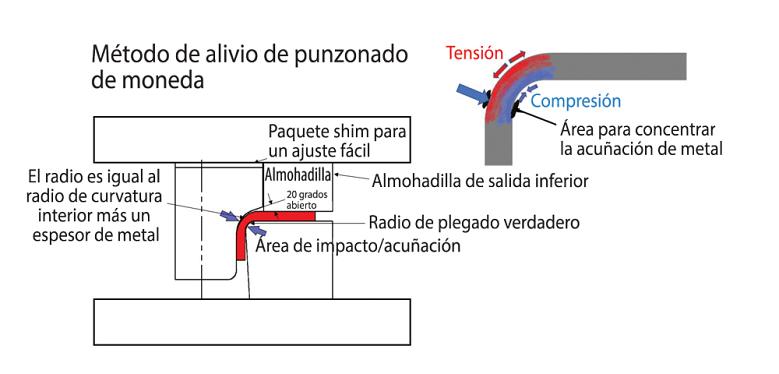
Controlling bend anglesBend angles are among the most frustrating geometric features to control in metal stamping. This is due primarily to two factors – the inconsistency of the mechanical properties in the metal being bent and the die design.
Publish date: October 9, 2003 |
|
|
Die geometry for embossing and stretchingStretching or embossing, not to be confused with drawing, is the process in which the part's geometry is obtained by stretching the metal into a forming cavity.
Publish date: August 28, 2003 |
|
|
Toolmaker tricksIt is not unusual for me to perform a few magic tricks when holding a conference on stamping die drawing, troubleshooting, or processing. Later on, I may disclose the magic behind the trick. I do this for a couple of reasons: first, to entertain the conference attendees, and second, to show them...
Publish date: August 14, 2003 |
|
|
Designing high-strength steel stamped parts for formabilityThe use of high-strength steel to manufacture automobiles and other transportation vehicles has increased dramatically. The material's strength allows manufacturers to reduce vehicle weight substantially and increase fuel efficiency, without sacrificing performance.
Publish date: June 12, 2003 |
|
|
Establishing a die setup recipe for progressive diesSetting up a stamping die is one of the most critical steps in a successful stamping process. It's a fact: More damage is done to a die, especially a progressive die, in the first 10 hits than in the next 10,000 hits. Most die damage happens during initial setup, when the material is being fed...
Publish date: April 10, 2003 |
|
|
Drawing on the strength of peopleDuring the recent economic downturn, sheet metal stampers, die shops, and some job shops experienced layoffs and some closed their doors. However, a few stampers have remained profitable despite uncertain economic times.
Publish date: April 10, 2003 |
|
|
Psychology for the tool roomAs a consultant for the sheet metal stamping industry, I have had the opportunity to visit numerous stamping plants, die shops, and engineering facilities. One comment I often hear during these adventures is how arrogant or "know-it-all" some of the toolmakers or engineers are.
Publish date: March 13, 2003 |
|
|
Why use sheet hydroforming dies?Most automobile manufacturers have looked for alternatives to the steel traditionally used in car production; hence, the introduction of high-strength steel.
Publish date: February 13, 2003 |
|
|
Reducing Negative TonnageOver time negative tonnage can cause significant press and die damage. Understanding the factors that influence the amount of negative tonnage can help you control it.
Publish date: November 21, 2002 |
|
|
Taking advantage of simulation technologyOne of the most valuable high-tech tools introduced in the last decade has been finite element analysis (FEA) simulation software that stamping tool makers can use to test forming conditions and design dies in the virtual world. This reduces tooling and product design time and saves costs of...
Publish date: October 24, 2002 |
|
|
Deep drawing aluminum—not as hard as it looksKeeping a couple key tips in mind can help you turn aluminum stamping from a source of frustration to a source of income and satisfaction in a hurry.
Publish date: October 10, 2002 |
|
|
Good design, set-up, maintenance can keep dies out of repair shopTake this old maxim to heart: A stitch in time saves nine. The same goes for die maintenance and repair.
Publish date: June 26, 2002 |
|
|
Getting the most from your deep-drawn materialLearning how to get every bit of flow out of your metal while minimizing scrap -- doesn't that sound like a good idea?
Publish date: March 14, 2002 |
|
|
Forming high-strength materialsVarious shape defects can be encountered in flat-rolled ferrous and nonferrous strip. Knowing their mechanics and origins and how to correct them can be very useful in times of need.
Publish date: January 31, 2002 |
|
|
The HOW, WHAT, and WHY of liquid impact formingLiquid impact forming, a patented process developed by Greenville Tool & Die Co., Greenville, Mich., uses a conventional stamping press with a liquid medium to manufacture parts that otherwise would require hydroforming.
Publish date: January 24, 2002 |
|
|
Part nesting and die design tips for reducing and utilizing scrap in stamping operationsYou might be able to gain a competitive edge by learning how to reduce the amount of engineered scrap, or that material that was inteded to be scrap rather than scrap created because of defective piece parts.
Publish date: November 15, 2001 |
|
|
Die design for double bendingKnowing how steel tends to react when it is bent in a single operation can help you do the job right the first time.
Publish date: October 11, 2001 |
|
|
Know your bending basics—Part IIWhen trying to make a good 90 degree bend with sheet metal, there's more than on way home. Just make sure your method can accommodate improvisation.
Publish date: July 26, 2001 |
|
|
Key design principles for successful deep drawingSuccessful deep drawing depends on many factors. Ignoring even one of them during die design and build can prove disastrous.
Publish date: May 30, 2001 |
|
|
Know your bending basics—Part IKnowing how metal bends and what factors come into play during bending—especially wipe bending—can make a positive difference in your stamping operation.
Publish date: May 15, 2001 |
|
|
Die design for flat parts: Achieving perfection in a difficult taskFlatness is one of the most difficult part characteristics to achieve in a conventional stamping die.
Publish date: February 19, 2001 |
|
|
Controlling flow and obtaining stretch in deep draw operationsAddressing the difficulties in obtaining a wrinkle-free stamped part requires a good understanding of metal flow and how it is affected by draw beads
Publish date: February 19, 2001 |